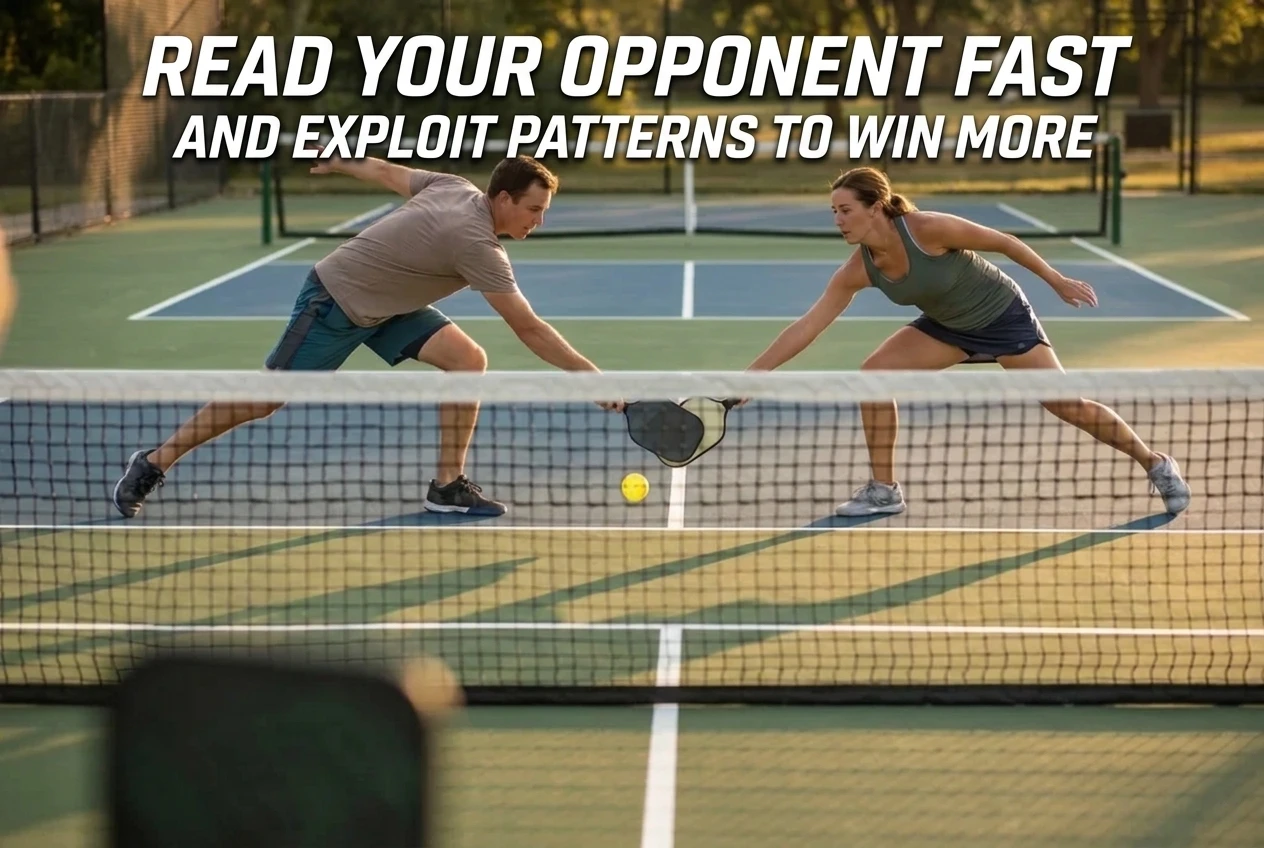
Most pickleball points are decided by habits, not by shots, which is why learning how to analyze your opponent in pickleball pays off so quickly. A player who always drives the third shot, always sends the dink cross-court to the same corner, or always drifts back after hitting will do it again on the next point. Intermediate players tend to lose to these habits because they spend the match thinking about their own shots and never register what the opponent repeats.
Knowing how to analyze your opponent in pickleball does not take a notebook or a coach on the fence. It takes a short list of things to watch, a cheap way to check what you saw, and the discipline to pick one counter and stay with it. This article gives you that routine, built for matches where there is no pause to think things over.
Why most players lose to patterns they never noticed
Between points you are busy: recovering from the last rally, checking the score, calling it, and getting ready to serve or return. Very little attention is left for the other side of the net, and what is left usually goes to the one opponent who hit the flashiest shot.
Patterns also hide inside variety. An opponent may hit a dozen different shots in a game and still send nearly every defensive ball to the same place. You only see that if you are asking a specific question each time, such as “where did that go when she was stretched?” A vague plan to “watch what they do” produces vague impressions, and impressions are easy to talk yourself out of.
The fix is to decide in advance what you are looking for. Four questions are enough, and they come up in almost every match.
The first five points: what to watch while you are still warming into the match
The opening points are the best time to gather information, because both sides are still settling in and playing closer to their natural habits. Nobody has started adjusting yet.
Give yourself a limited job for those points. You are not trying to win a debate about the opponent’s whole game. You are collecting a first impression on each of four tells, writing nothing down, and holding the impressions loosely. Play your normal game, keep your shot selection safe, and let your eyes do the extra work.
Two practical habits help:
- Watch the opponent while the ball is going to your partner or while you wait at the line, not only when the ball is on your side.
- Keep a short mental tag for each tell, like “backhand cross” or “drifts back,” so you can compare it with the next point instead of re-deciding from scratch.
If you are on the serving side, the first points also give you a look at how the returners set up. Where do they stand, and how quickly do they get to the kitchen line?

Four tells that show up in almost every opponent
1. Where they go under pressure
Pressure here means a ball at their feet, a ball that pulls them wide, or a ball hit harder than they expected. Watch the shot they choose when they cannot attack. Some players block it back cross-court. Some push it straight at the person who hit it. Some lob. Some swing harder than the ball deserves.
An opponent with a favorite escape shot is predictable, because the situations that create pressure are ones you can create on purpose.
2. Which side they attack
When you give an opponent a ball they can speed up, notice where they aim it. Many players go after the backhand side of the player in front of them. Others prefer the body, the middle, or the open space. Notice also which side of their own court they hit well from, and which side they would avoid if they had a choice. A weak backhand often shows up as a pop-up, a shorter dink, or a wild swing. If this is the tell that matters in your match, our piece on pickleball backhand strategies covers how to build a reliable backhand of your own.
3. How they respond to pace changes
Give them a few slow dinks, then one faster ball. Or trade hard drives and then hit a soft drop. Some opponents handle speed well but get impatient with soft balls and pop them up. Others are comfortable in a dinking rally but flinch when the ball comes in quickly. How a player reacts to a change of speed tells you which speed to make them play.
4. Their footwork recovery
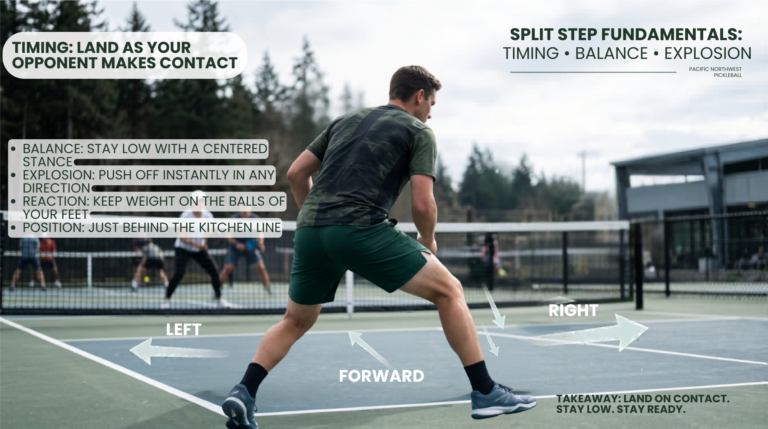
After a shot, do they return to a ready position with a split step, or do they stand still and admire the ball? After a dink, do they stay at the kitchen line or back away from it? Slow recovery is the most reliable tell for good attacking chances, because it means the next ball arrives while they are still moving or out of position.
Look for the ready position at the moment you contact the ball, not at the moment of their own contact. That is when it counts.
Test before you trust: low-risk ways to confirm a pattern
One point is an anecdote. Two points that match start to look like a pattern. A deliberate test is faster than waiting for the pattern to repeat on its own, and a good test costs you very little if you are wrong.
Run the test during a neutral rally, when the shot you would normally play is safe anyway. Some examples, one per tell:
- Pressure: Send one firm ball at their feet or hip and watch what they do with it. Do it again a few points later. If the response is the same twice, you have your pressure habit.
- Side: Hit three or four neutral dinks to one side and then to the other. Watch the quality of the return from each. The side that produces higher or shorter balls is the weaker one.
- Pace: After a soft exchange, mix in one quicker ball with a margin over the net. Then after a faster exchange, drop in a soft one. See which change costs them.
- Footwork: Play a ball just short of where they are standing after they have hit. Check whether they get to it with balance or reach for it.
Keep the tests small. Do not gamble a point on a shot you have never tried in a match just to learn something. If the test gets a clear response, it was worth the point. If it gets a mixed response, drop that tell and move on to another.
Matching the counter to the tell: dinks, resets, speed-ups and lobs
Once you have confirmed a tell, choose one counter and commit to it for several points. Switching every rally erases the information you just paid for.
What you found Counter to commit to Weak under pressure, pops the ball up or goes wild Drive or speed up to their feet and set up to put away the pop-up Weak on one side Dink or drive to that side until they change something Handles speed but gets impatient in slow rallies Keep the rally soft with patient dinks until they overhit Handles dinks but is uncomfortable with speed Speed up from a good position, and reset the ball if they block it back hard Slow footwork recovery Hit the ball short and low, or to the space they just left Stays back or drifts back after hitting Drop or dink short to bring them forward, and lob if they crowd the line
A few notes on each counter.
Dinks. If your plan depends on a long, patient dinking rally, your dink has to be consistent first. Our pickleball dinking drills are a good place to build that.
Resets. If an opponent is firing balls at you from a strong position, a soft reset into the kitchen takes away their advantage. It also tests how they react when the pace drops.
Speed-ups. Speed up only when the ball is high enough to attack and you have a target. An attack from a poor position tends to give the point back. When your third shot is the problem rather than the opponent, see why your third shot drop keeps popping up.
Lobs. A lob works best against players who crowd the kitchen line or who are slow to turn and retreat. Hit it only when you have time to set up and you know the overhead you will get back is not a strong one. If your own overhead needs work, try the pickleball overhead shot drills.
Reading a team: finding the weaker partner without being obvious
In doubles, you are reading two players, and the pattern you need is often the difference between them. Look at which partner pops the ball up more, which one avoids backhands, which one gets pulled out of position, and which one is slow to get back after a speed-up.
Once you know, resist the urge to hit every ball at that player. Opponents notice a steady stream at one person, and the stronger partner will start to shift toward the weaker one’s side to take some balls. Instead, aim most balls at the weaker player but mix in the occasional ball to the other, so the stronger partner has to stay in their own area.
The middle is also useful. When two players are unsure who takes a ball, the middle produces hesitation. Watch whether the team calls balls early and clearly, or whether you see two paddles reaching for the same ball. Hesitation in the middle is often a better target than either individual.
When the opponent adjusts back: staying one step ahead
Good opponents will notice that you are pressing on a weakness, and they will adjust. They may move over to cover the weak side, change their target, or try the same trick against you. That adjustment is information too.
Plan for it:
- Keep a second counter ready before you need it. If they start covering the backhand side, the open space on the other side becomes your target.
- Notice what the adjustment costs them. If they leave one spot to protect another, that spot is now the one to attack.
- Do not abandon the first counter completely. Return to it once in a while so they cannot settle into their new position.
If you fall behind while working all of this out, the mental side of that situation is covered in how to stay steady when you’re down 8-3 in a pickleball tournament match. This article stays on the tactical side.
A pocket scouting routine you can use in your next match
Here is the whole routine in a form you can carry onto the court.
- Points 1 to 2: Watch where the opponent goes under pressure and which side they attack. Tag each with a few words.
- Points 3 to 4: Watch how they handle a change of pace and how they recover after a shot.
- Point 5: Choose the one tell that looks strongest, and pick a small test for it.
- Points 6 to 8: Run the test two or three times in neutral rallies. Keep the shots safe.
- After the test: If the response is clear, choose one counter and commit to it for at least several points. If it is not, choose the next tell and test that instead.
- Each side-out or change of server: Check whether they have adjusted, and move to your second counter if they have.
You will not catch everything, and you will sometimes read a pattern that is not there. That is fine. A rough read that you test and act on will beat a careful read you never use.
Pick one tell from this article and run it in your next match, then take your result to a coaching session so we can build the counter into your game.