Your pickleball tournament mindset is the set of habits you run before, between, and during matches, and you can build it the way you build a dink: with repetition. Players who look sharp in open play and stiff in competition usually have the same shots in both settings. What changes is how they handle the day around the shots.
This plan follows a tournament day in order: the night before, the warm-up, the walk to the court, the time between points, and the long waits between matches. Each section gives you one ritual or mental strategy to practice before the event. If you want help with the specific moment you fall behind in a game, that is covered separately in how to stay steady when you’re down 8-3.
Why you play worse in tournaments than in open play
In open play, a missed dink costs you nothing. You swing freely, so your body does what it has practiced. In a tournament, the same miss changes a score that someone is tracking, and your body reacts to that.
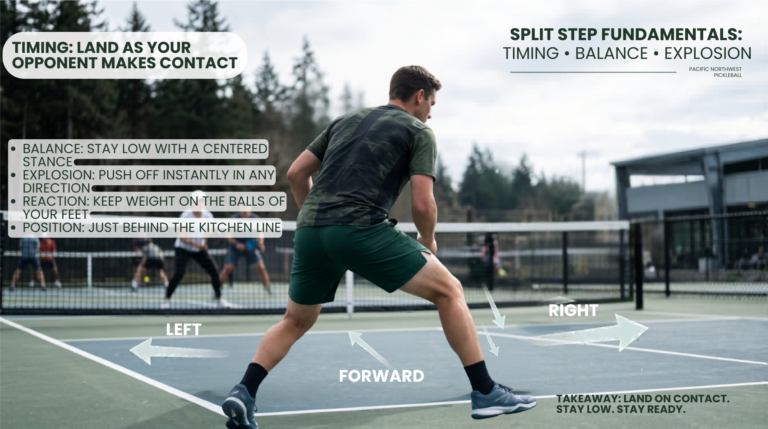
Common physical signs are a faster heartbeat, shallow breathing, a tighter grip on the paddle, and feet that stop moving. A tight grip and still feet cause most of the errors players blame on “nerves.” Your wrist loses feel on soft shots, you reach instead of stepping, and a shot you would normally roll over the net gets steered.
Players also change their strategy under pressure. They try to hit winners too early, or they stop attacking and push every ball back safely. Both come from wanting to end the discomfort of the point quickly.
Unfamiliar conditions add to it: a different court surface, a different ball, strangers watching, a schedule you do not control. Each is a small stressor, and together they take attention away from the ball. The goal of everything below is to make as many of those conditions as possible feel ordinary by the time you walk on.
Set a process goal before you set a medal goal
A medal goal depends on opponents, line calls, and luck. A process goal depends only on you, so it gives your attention somewhere useful to go when the score gets tight.
Pick one or two process goals for the day, and write them on a card or in your phone notes. Good ones are specific actions you can check after every match:
- Take one full exhale before every serve.
- Dink patiently until a ball sits high enough above the net to attack.
- Hit the third shot to the kitchen, even when the first one in the match goes wrong.
- Move your feet to the ball before choosing the shot.
After each match, ask whether you did what you planned. You can win a match and miss your process goal, and you can lose one and hit it. Over several tournaments, the process record tells you more about your progress than the results do, because it shows what you control.
Keep a medal goal if you want one, but check it only after the event. During the day, your attention belongs on the card.
The night-before and morning-of routine that removes decisions
Every decision you make on tournament morning draws on attention you would rather spend on pickleball. The fix is to make those decisions the night before, or to make them the same every time.
The evening before:
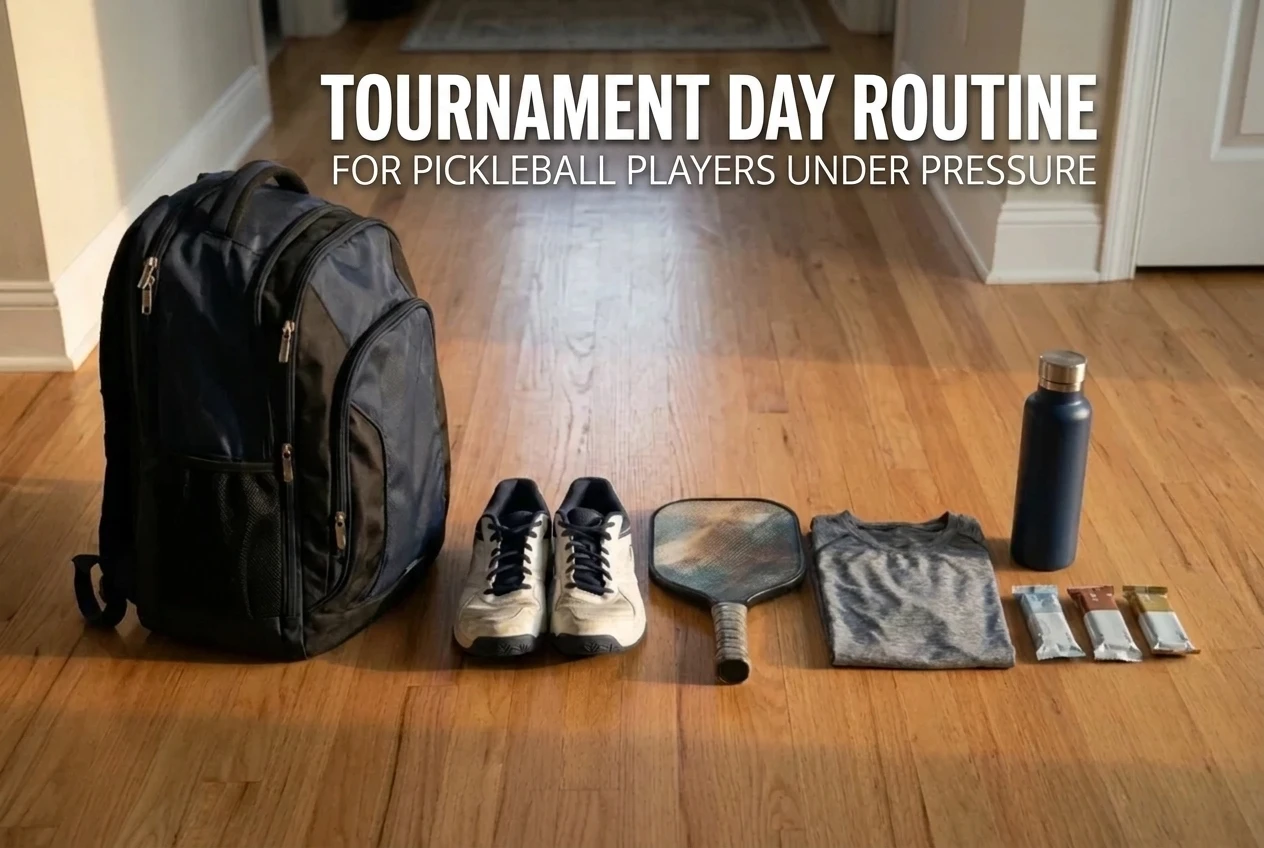
- Pack your bag completely. If you need a checklist, what actually goes in a tournament pickleball bag covers what to bring and what to leave behind.
- Lay out your clothes, shoes, and any braces or sun protection.
- Check your first match time, the venue address, parking, and how long the drive takes.
- Decide what you will eat for breakfast and which snacks go in the bag.
Keep the gear and food the same as what you use in practice. A new pair of shoes, a freshly taped paddle, or an unfamiliar breakfast adds variables you cannot test under pressure. If you want to change your equipment, do it weeks before an event, not the night before.
On the morning itself, follow the same order every time: wake up, eat, dress, drive, arrive early enough that you never rush. Arriving rushed raises your heart rate before you have hit a ball, and you spend the first match recovering from it. Build in extra time for parking, check-in, and finding your court.
A warm-up that doubles as a focus reset
A good warm-up prepares your body, and a good tournament warm-up also moves your attention from everything else in your life to the ball. Treat it as the first stage of your match routine, not as a chore before it.
Start off the court with light movement: a short walk or jog, arm circles, hip openers, and lateral shuffles. Many events give limited court time before a match, so check the format and plan what you can do without a court.
Once you have the ball, work from soft to hard:
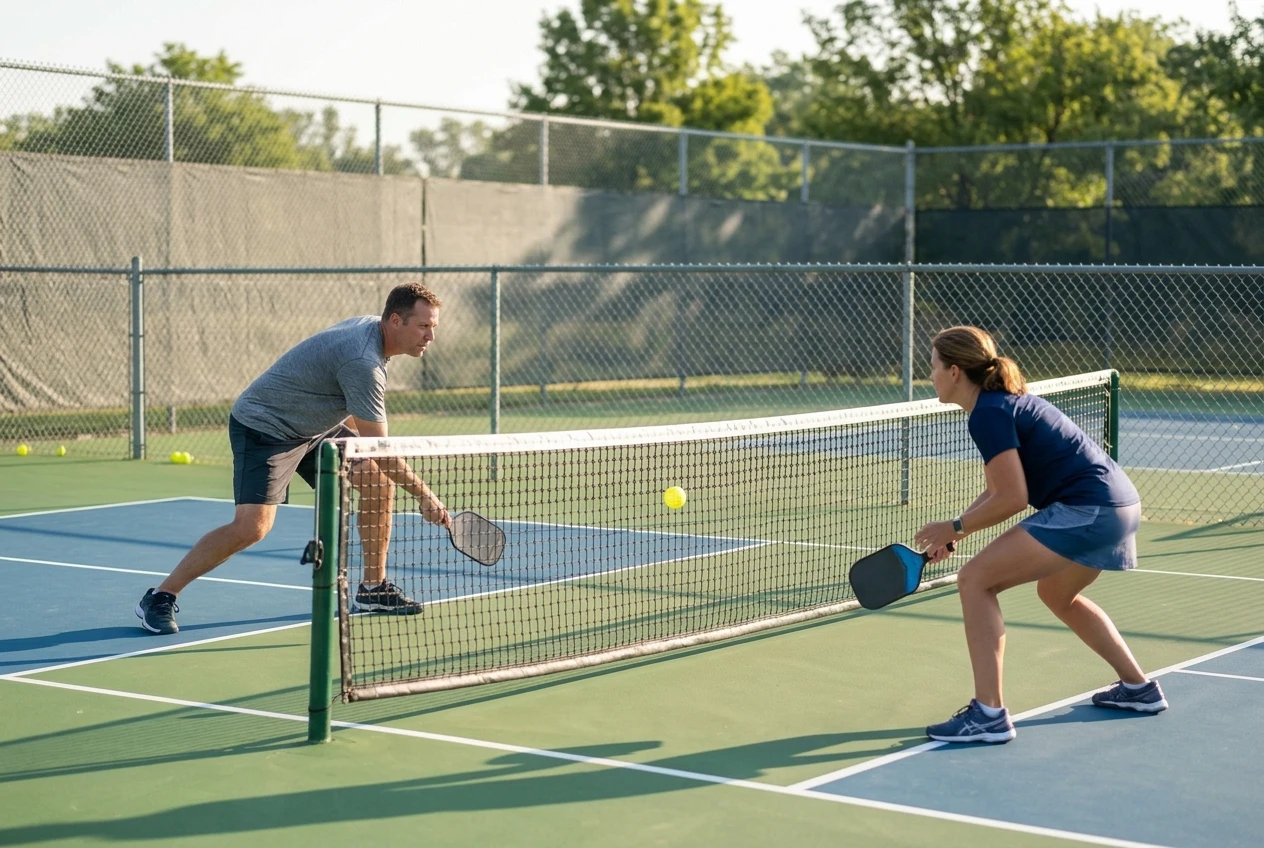
- Dinks from the kitchen line, crosscourt and straight ahead.
- A few volleys at the line, then a few resets from mid-court.
- Third shot drops from the baseline.
- Serves and returns to specific targets.
- A couple of overheads, if your partner can lob.
Finish with a deliberate reset. Hit your last few serves to a target, and make the last one count: aim, breathe out, and commit to the shot. Then take one slow breath and read your process goal. If you walk onto the court after that, you carry the feeling of a controlled routine into the first point.
If your warm-up gets cut short or the court is crowded, run the same sequence in your head. The order matters more than the length.
The 10 seconds between points: a ritual you can repeat every rally
Most mental mistakes in a match happen between points, not during them. You replay the last error, worry about the next one, and start the following rally with your attention somewhere else. A short ritual gives that gap a fixed job.
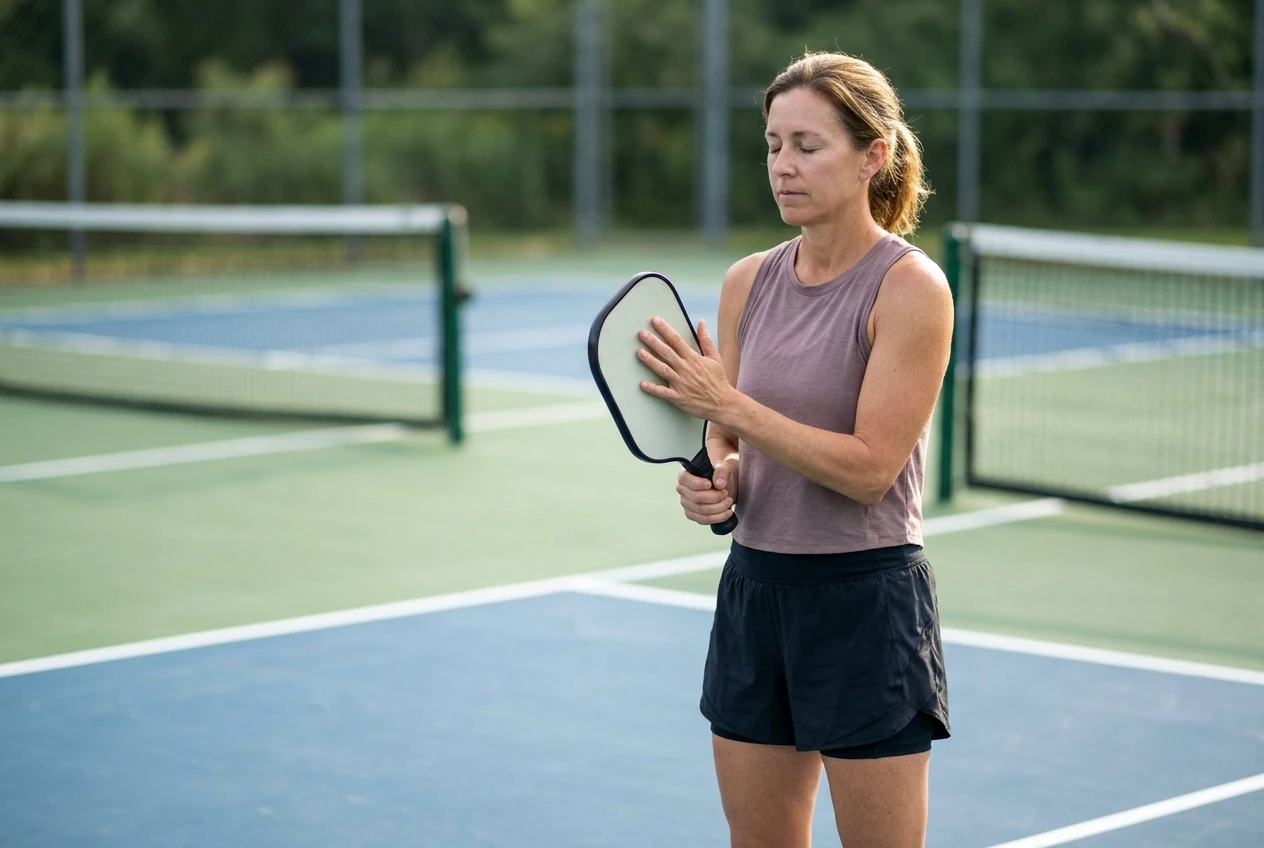
A workable version has three parts:
- Release. Turn away from the net or walk toward the baseline, and tap your paddle against your palm or your leg. This marks the previous point as finished.
- Breathe. Take one long exhale, slower than your inhale. It loosens your grip and shoulders.
- Plan. Say one sentence to yourself about the next ball: “Serve deep to the backhand,” or “Dink crosscourt and wait.”
Then set your feet and look at the ball. Keep the ritual inside the time the serving rules allow, and confirm those rules for your event.
The ritual only works if it is automatic, so practice it in open play and drills until you do it without thinking. If you play doubles, agree on a short cue with your partner, such as a paddle tap, so the reset is shared and fast.
What to tell yourself when nerves hit
Self-talk works best when it describes an action. Your brain follows the picture you put in it, and “Don’t hit it into the net” puts the net in the picture.
Phrases worth using:
- “Next ball.”
- “Soft hands.”
- “Move my feet.”
- “Breathe out, then serve.”
- “My body is getting ready.” This treats the racing heart as preparation, which it is.
Phrases to stop saying:
- “Don’t miss.” It names the miss and gives you nothing to do.
- “I always choke in these.” It treats a few past matches as a fixed fact.
- “I can’t lose to these guys.” It makes the result the focus, and it makes every error feel like a disaster.
- Anything you would not say to a friend who was playing next to you.
If you notice yourself spiraling, shorten the plan. Pick one target for the next point and one cue word. The aim is to give your attention a single task, not to feel calm. Players often play well while still feeling nervous, so you do not need to wait for the feeling to pass.
Surviving the gaps between matches
A tournament day can mean long waits, several matches, and little structure. The risk is arriving at your later matches tired, hungry, or mentally worn from replaying earlier ones.
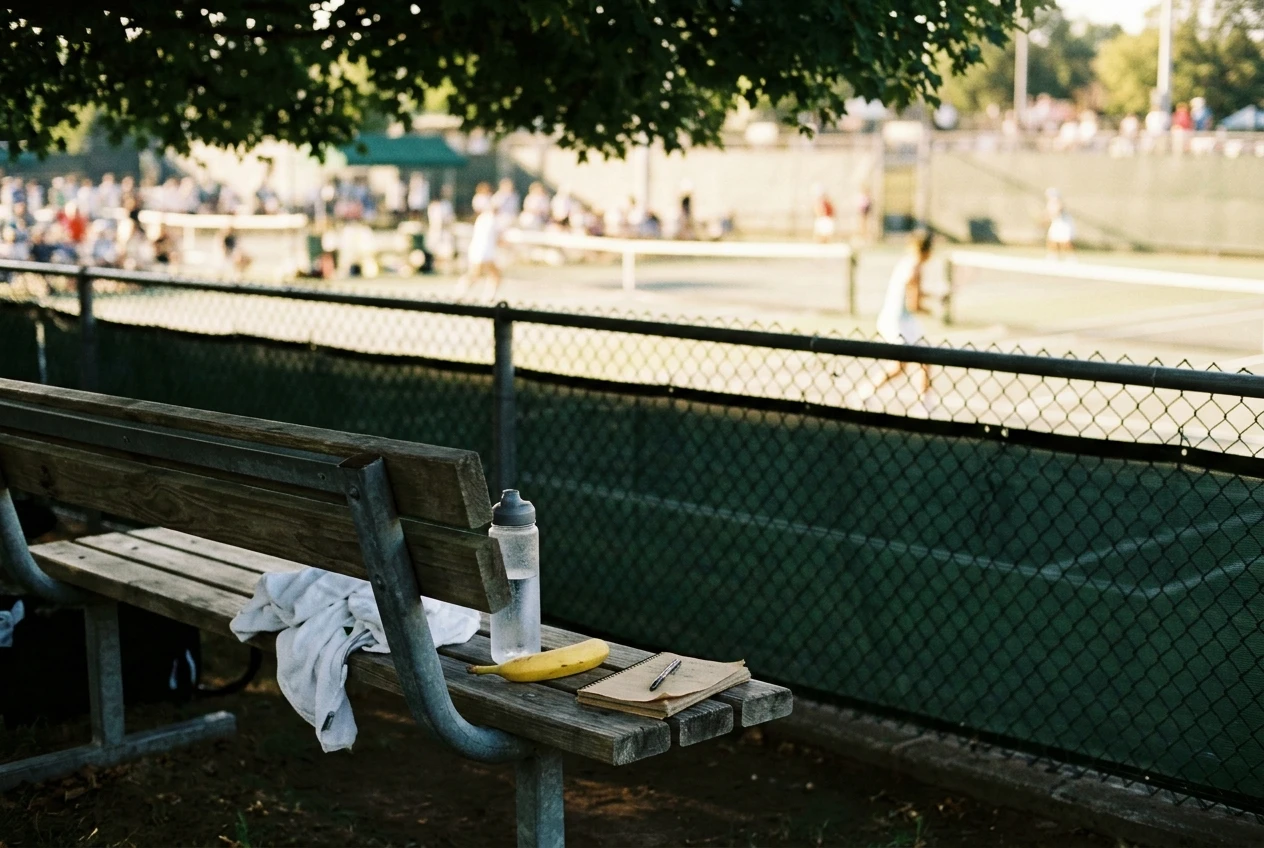
Treat the gap as recovery time with a plan:
- Eat and drink early. Have the snacks you already know your stomach handles. Small amounts regularly work better than one large meal right before a match.
- Find shade or a quiet seat. Sit away from the courts if the noise keeps your heart rate up.
- Keep your legs loose. Walk a little and stretch lightly so you do not start the next match stiff.
- Do a one-minute debrief. Write one thing that worked and one thing to adjust, then close the notes. Replaying the full match wastes energy.
- Limit your phone. Scrolling and checking brackets constantly keeps your mind on results rather than your next process goal.
- Reset your gear. Dry your hands, change a damp shirt, and check your grip.
Run the same routine after a loss and after a win. A win can make you careless, and a loss can make you rush to fix everything. Either way, the next match is a fresh game, and your routine is what carries over.
Rehearse pressure in practice so game day is not the first time
You cannot remove pressure on tournament day, but you can make it familiar. That requires practice that has something at stake.
Some ways to add it:
- Start games at a tight score. Begin at 8-8 or 9-9 and play it out. Do this regularly, so close scores become routine.
- Add a consequence. The losing pair buys the drinks or collects the balls. A small stake is enough to raise your pulse.
- Make your drills count. In a drill such as target box training, set a number of hits to reach, and start over if you miss. This creates a pressure moment without needing an opponent.
- Use your ritual every point. Run the release, breathe, and plan routine in every practice game, not just on tournament days.
- Rehearse the full day once. Pick a practice session and follow your night-before and morning-of routine, warm-up, and between-game habits exactly.
- Play a local event or ladder. A low-stakes competition lets you test the plan with real scores and unfamiliar opponents.
After each practice, note whether you kept to the ritual and whether your grip and footwork changed when the score got close. Those notes show which part of the plan needs more repetition. Choose one ritual from this article, use it at your next session, and add the others as each one becomes automatic.