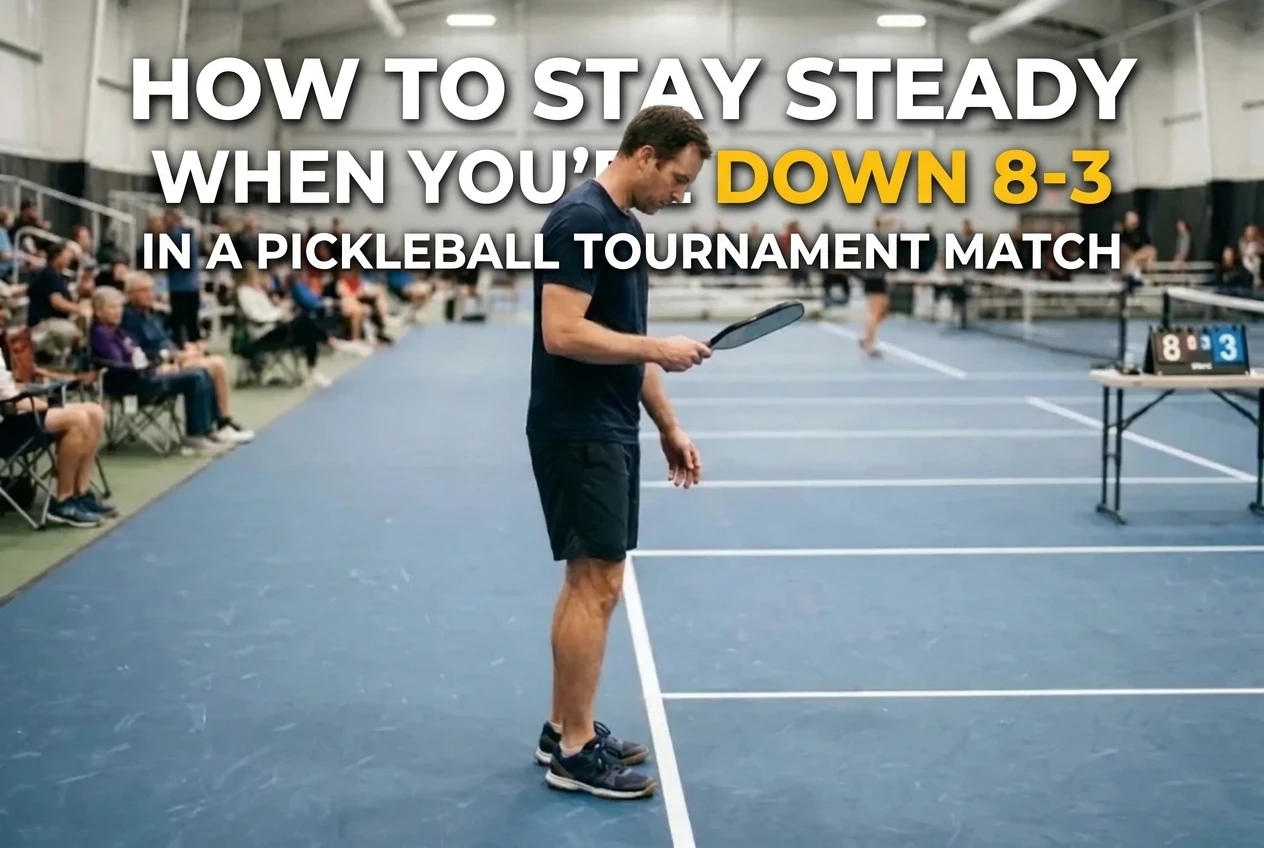
Mental toughness in pickleball is easier to describe than to use. Most advice says “stay positive” and stops there, which doesn’t help at 8-3 down with a crowd on the next court and your hands shaking. What helps is a short routine for each specific moment that breaks players, one that fits in the 10 to 15 seconds between rallies and has been rehearsed enough to run without thinking.
This article gives you that toolkit: four match-breaking moments, a ten-second reset, plans for big deficits and big leads, ways to handle bad calls and gamesmanship, practice games that add pressure, and a tournament-week routine.
Why you play worse in tournaments than in practice
In practice, a missed dink costs you nothing. In a tournament, the same miss feels like it counts for more, so your attention moves from the ball to the result. You start thinking about the score, the bracket, who is watching and what you will say afterward.
That shift shows up in the body first. Shoulders rise, grip pressure goes up, breathing gets shallow and footwork gets lazy because you are thinking instead of moving. A tight grip alone can turn a soft drop into a pop-up.
Tournaments also change the pace. Matches are scheduled, warm-ups are short, and you face opponents whose patterns you don’t know. Practice partners are familiar and the stakes are low, so you have never rehearsed the feelings that come with unfamiliar opponents and real stakes.
You can’t remove those feelings. You can build habits that work while they are present, and that is what the rest of this piece covers.
The four moments that break your match (and what each one is really about)
Most lost tournament matches turn on one of four moments. Each one feels different, but each has a cause you can address.
A bad run of points. You lose four or five in a row, usually from a mix of errors and a hot opponent. The real problem is that you start replaying the last point while the next one is being served. Your attention is a point behind, so you lose another. The fix is to close the previous point on purpose, which the reset in the next section does.
A bad call. A ball you saw in is called out, or a close one goes against you. The feeling underneath is unfairness, and unfairness keeps you arguing with the past. The fix is to decide in advance how you will respond (one calm question at most), then return to the next serve.
A nervous first game. You are tight, you steer shots instead of swinging, and you play to avoid errors. This is about outcome focus: you are playing the result instead of the rally. The fix is a small, concrete task for each point, such as a deep serve or soft hands at the kitchen line, so your mind has something to do besides worry.
A lead slipping away. You were up 8-3 and now it’s 8-7. Players in this spot usually start protecting the lead, which means slowing down, hitting safer and more tentative shots, and handing over the initiative. The fix is to keep playing the patterns that built the lead.
A between-points reset you can finish in ten seconds
A reset only works if it is short enough to run every point, including the ones you win. Here is a version in three parts. Practice it until you don’t have to think about the order.
- Release (about three seconds). Walk toward your position and let your shoulders drop. Open your paddle hand, shake it out once, and look at your paddle face or strings. This tells your body the last point is over, and it loosens the grip that nerves tighten.
- Breathe (about four seconds). Take one slow breath in and a longer one out. A longer exhale is a simple way to settle your body, and one breath is enough. You don’t need a breathing exercise.
- Aim (about three seconds). Choose one task for the next point and say it to yourself in a few words. “Deep serve, backhand side.” “Dink cross-court, wait for the high ball.” “Let it bounce.” The task should be something you control, not a result like “win this point.”
The Aim step matters most. A mind with a clear job has less room for worry. Keep a small menu of cues you trust and choose from it instead of inventing one under pressure.
If your partner is in the match with you, add a quick paddle tap or short phrase at the end of the Release. Doubles teams often lose their composure together, and a shared habit helps both players reset.
What to do when you’re down big, and when you’re up big
When you’re down 8-3
At 8-3 in a game to 11, you are behind by five points. In side-out scoring, only the serving side scores, so you also need to win serves back before you can score at all. That sounds bleak, but it points to a practical plan: win the next rally, then the one after.
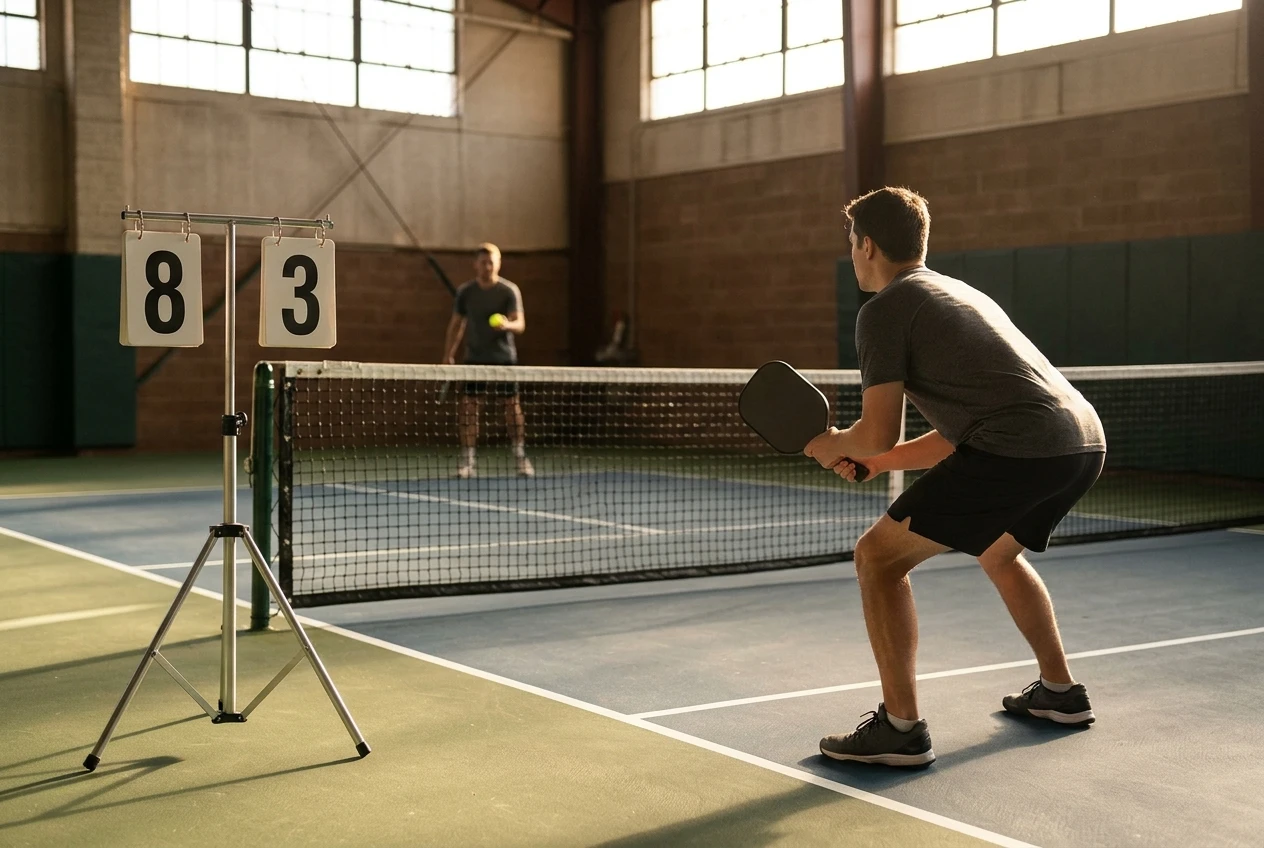
- Shrink the game. Ignore the scoreboard and play to win the next serve, then the next point. A five-point deficit is made of single rallies.
- Change one thing, not everything. Players who panic switch strategy, pace and shot selection all at once. Choose one adjustment: deeper returns, more patient dinks, or targeting one opponent. Then give it several points to work.
- Make the opponent hit. Under pressure, the safest plan is to put the ball in play and let the other team make errors. Your opponents may be feeling their own nerves with a lead.
- Use a timeout if you have one. Timeouts break an opponent’s rhythm and give you a chance to reset your own. Use them early in a bad run, before it grows.
When you’re up big
A big lead is as risky as a big deficit because the temptation is to relax or to try to finish quickly.
- Keep the same tempo. Don’t speed up your serve routine or rush at the kitchen line. Run the full reset every point.
- Keep the same patterns. The shots that built the lead are the shots that keep it. Don’t get fancy, and don’t suddenly get conservative.
- Treat it as 0-0. If the lead shrinks, return to the Aim cue and play one point at a time. A game isn’t over until someone reaches the winning score by the required margin.
Handling bad line calls, sandbaggers and gamesmanship without losing your head
None of these three things is under your control, so the aim is a pre-decided response that costs you as little attention as possible.
Bad calls. In matches without referees, players call the lines on their own side, and a ball that can’t be clearly seen out is generally treated as in. If you disagree, you can ask once, calmly, whether the opponent was sure. If the call stands, move on. If a referee or tournament director is available and the problem repeats, ask for one to watch the match instead of arguing mid-rally. If you are unsure about a rule, the pickleball gameplay rules summary is a quick reference to read before match day.
Sandbaggers. A sandbagger is a player who enters a bracket below their real level. You can’t fix that, and complaining about it during the match only helps them. Treat the opponent as the level they play: adjust your targets, watch what they struggle with, and use your normal plan. Take any complaint to the organizers after the match.
Gamesmanship. Slow-rolling between points, stalling, trash talk, and loud celebrations are designed to get a reaction. Don’t give one. Run your reset, keep your pace, and stand where you normally stand. If stalling breaks the rules, ask politely for a referee.
A useful rule for all three: allow yourself one sentence, then go back to the next serve. After the match, you can be as annoyed as you like.
Practice games that train pressure, not just shots
Drilling shots builds technique. It doesn’t build the ability to use technique with a fast heartbeat. For that, you need games with consequences. Try these in your regular sessions:
- Start at 8-3 down. Play a game from a five-point deficit and practice the shrink-the-game plan. Swap sides and play it from the leading side too, so you rehearse protecting a lead without going passive.
- Serve under pressure. Before a practice game, you and your partner each have to land a set number of deep serves in a row. Missing means starting over. It is low-tech, and it exposes how your grip and routine change when a miss costs something.
- Make every point count double late. In the final points of a game, award a bonus or apply a small penalty (loser picks up the balls, for example). The stakes are small, but they are enough to create a little tension.
- Call your own lines. Play with no referee, and make the partner who disagrees with a call use your calm-question routine. This rehearses the feelings without the real conflict.
- Run the reset every point. Use it even when you win the point. A routine that only appears when things go wrong won’t be automatic when they do.
When you work on a specific skill that tends to fail under stress, such as the third shot, test it in these games instead of only in drills. If that shot keeps popping up when the score is close, why your third shot drop keeps popping up goes through the common causes.
Your tournament-week routine: the night before, warm-up and first three points
The night before
Decide logistics early so you don’t spend match-day attention on them. Pack your bag, including paddles, shoes, water, snacks, towel and a spare overgrip. Check your match time and travel, and plan to arrive with enough time to warm up without rushing. Eat a normal meal, and try to sleep at a regular hour.
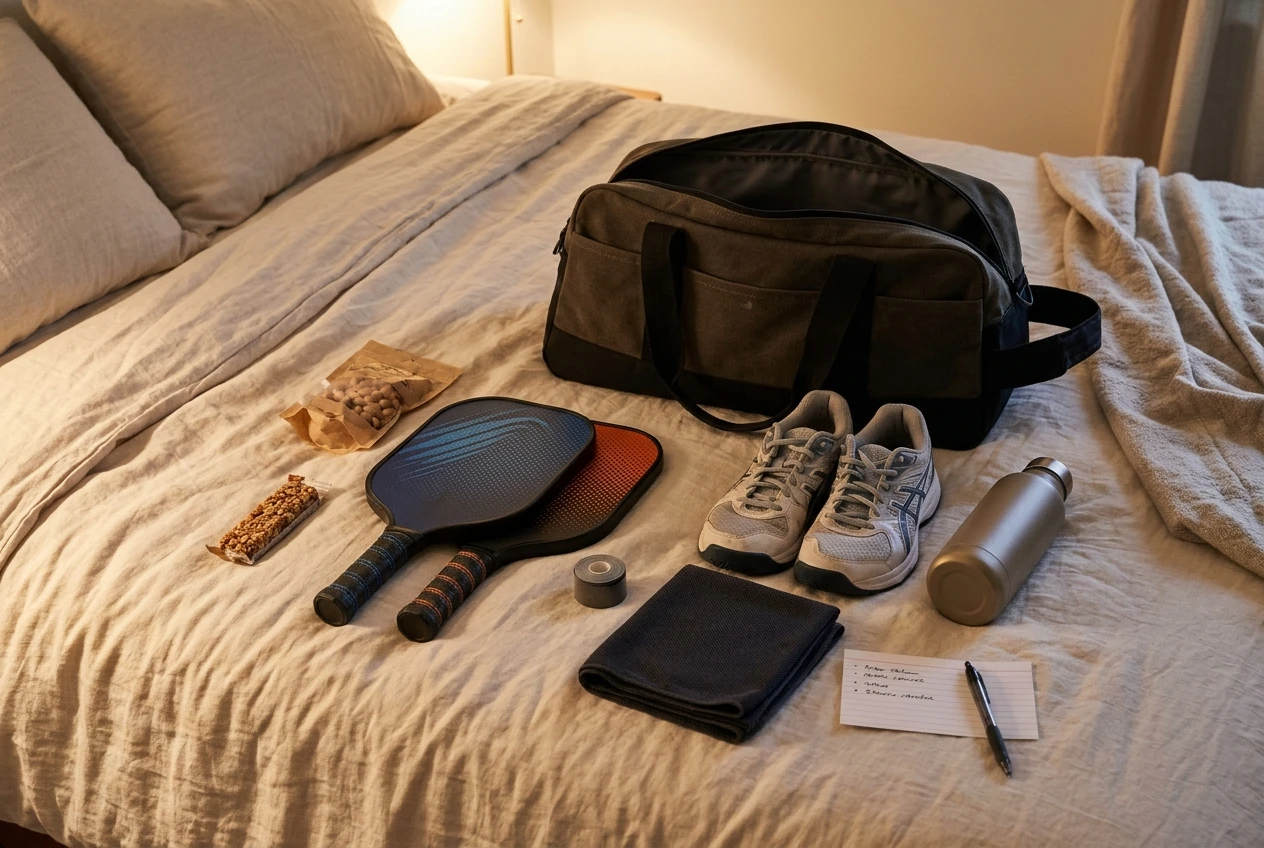
Then write a small card with three to five Aim cues you trust, such as “deep serve,” “soft hands,” and “let it bounce.” Keep it in your bag and read it before you play.
The warm-up
Use the warm-up for both your body and your routine. Hit dinks, drops, drives, returns and serves, and finish with a few overheads and a few points at the kitchen line. Practice your reset once or twice, including the breath and the cue, so the first time you use it isn’t during the match.
If you only get a short court warm-up, spend it on the shots you need first: serves, returns and soft shots at the kitchen. Skip any shot you are still learning, since a bad warm-up on it can shake your confidence.
The first three points
Your first three points set your nerves for the game, so give them simple jobs:
- Serve deep and in. A deep serve limits the opponent’s options and gives you an easy first win.
- Return deep and move forward. Reach the kitchen line, where you control the pace.
- Make the opponent hit a tough ball. You don’t need winners yet. Get in rhythm, let errors come, and run the full reset after each point.
If you lose all three, nothing is lost. Use the reset and begin again.
Pick one reset routine from this article and rehearse it in your next three practice games, then read the footwork drills guide to build the physical side of staying composed under pressure.