You can hit your third shot drops cleanly all week and still send the same shot into the net in a tournament match. The shot did not change. What changed is your breathing, your attention, and how fast you play between points. Those are habits, and learning how to train mental toughness for pickleball starts with seeing that habits can be trained in practice before the event.
This article is a plan for how to train mental toughness for pickleball in the weeks before a tournament. It covers a between-point routine, drills with pressure added, practice-game rules, a reset for the short time between points, and a short written review after matches. If you want help with a match that is already going badly, the in-match piece is linked in the final section. This one is about building the skill earlier.
Why you play like a different person in tournament matches
Practice and tournament play differ in a few specific ways, and each one can be reproduced in practice.
- Consequences. A missed dink in a warm-up rally costs nothing. In a bracket match it costs a point that counts toward advancing.
- Attention. In practice your attention is on the ball. In a match it drifts to the score, your partner, the people watching, and what a loss would mean.
- Tempo. Nervous players tend to speed up. They rush the serve, rush the reset, and hit shots before their feet are set.
- Unfamiliar conditions. A new venue, a different ball, and an unfamiliar court surface take some attention that you normally spend on the game.
Tightening up has a physical side too. Shoulders rise, grip pressure increases, breathing gets shallow, and your touch shots lose their softness. Dinks and drops depend on a light grip and a relaxed arm, so they are usually the first shots to go.
The training below works on two things. One is a routine that keeps tempo and attention steady. The other is practice that includes enough pressure that tournament pressure is not new.
Build a between-point routine you can run on autopilot
A routine is a fixed sequence of actions between the end of one point and the start of the next. Because the sequence is the same every time, you do not have to decide anything while you are nervous. You just run it.
A workable routine has four parts:
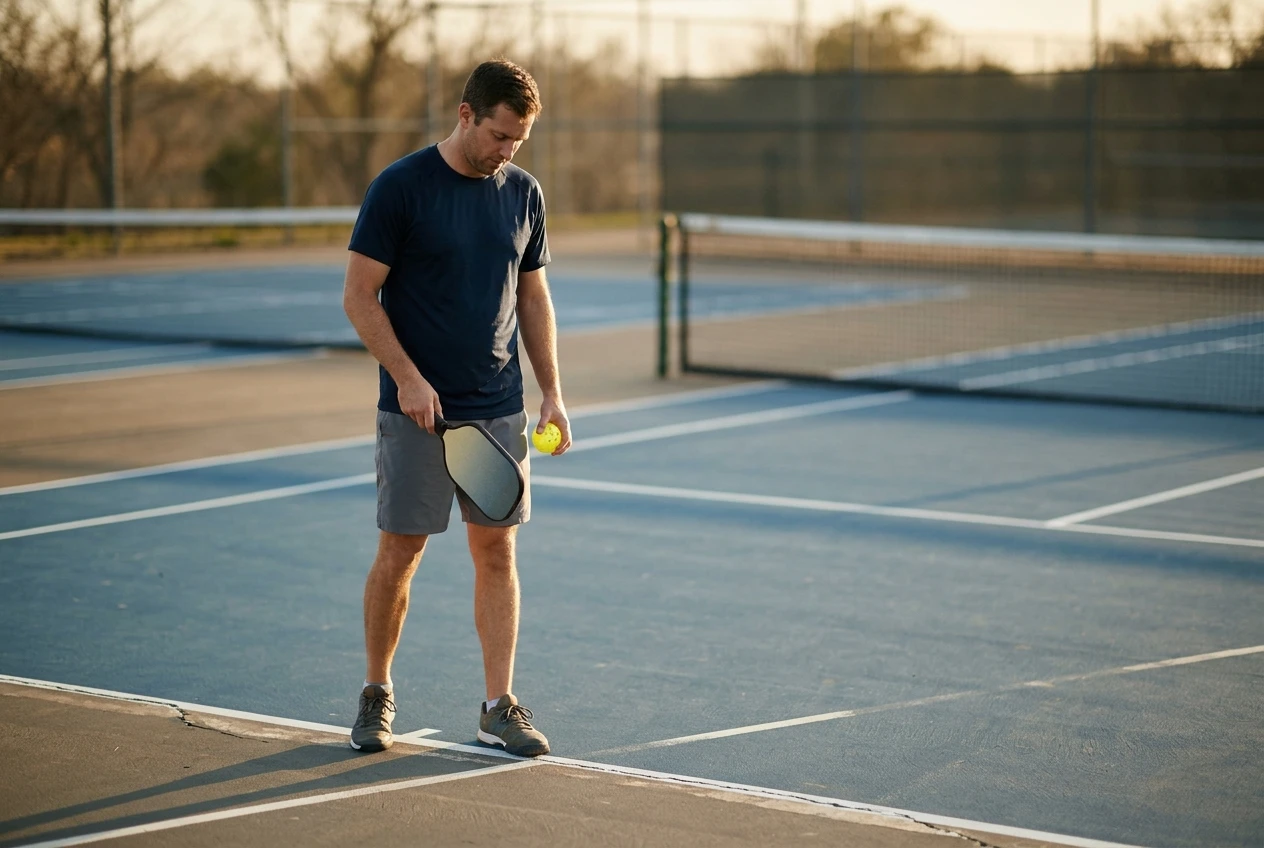
- Release the last point. Look at your paddle or the ground for a moment and let the point end. Some players turn away from the net or walk a few steps toward the baseline. Pick one physical action and always use it.
- Breathe. Take one slow breath, with the exhale longer than the inhale. The next section covers this in more detail.
- Set one intention. Pick a single simple instruction for the next point, such as “dink crosscourt” or “split step on their contact.” Keep it about what you will do, not about the score.
- Take your position and serve or receive at your normal pace. Use the same ball bounce, the same stance, the same visual target.
The routine should take roughly the same time after a winner, an error, a bad line call, or a long rally. That consistency is the point. If your routine is long after mistakes and short after good points, you have a routine that depends on your mood.
Start using it in every practice game, including casual ones. A routine used only in tournaments will not run automatically, because it was never repeated enough. Give it two or three weeks of regular use before you judge whether it works.
Add pressure to the drills you already do
Most drills are done with nothing at stake, so they measure how well you can hit when relaxed. To train under pressure, add a result to the drill. Use the same drill and put a score, a consequence, or a requirement on it.
Here are two ways to do that with drills you may already use.
Target drills with a streak requirement
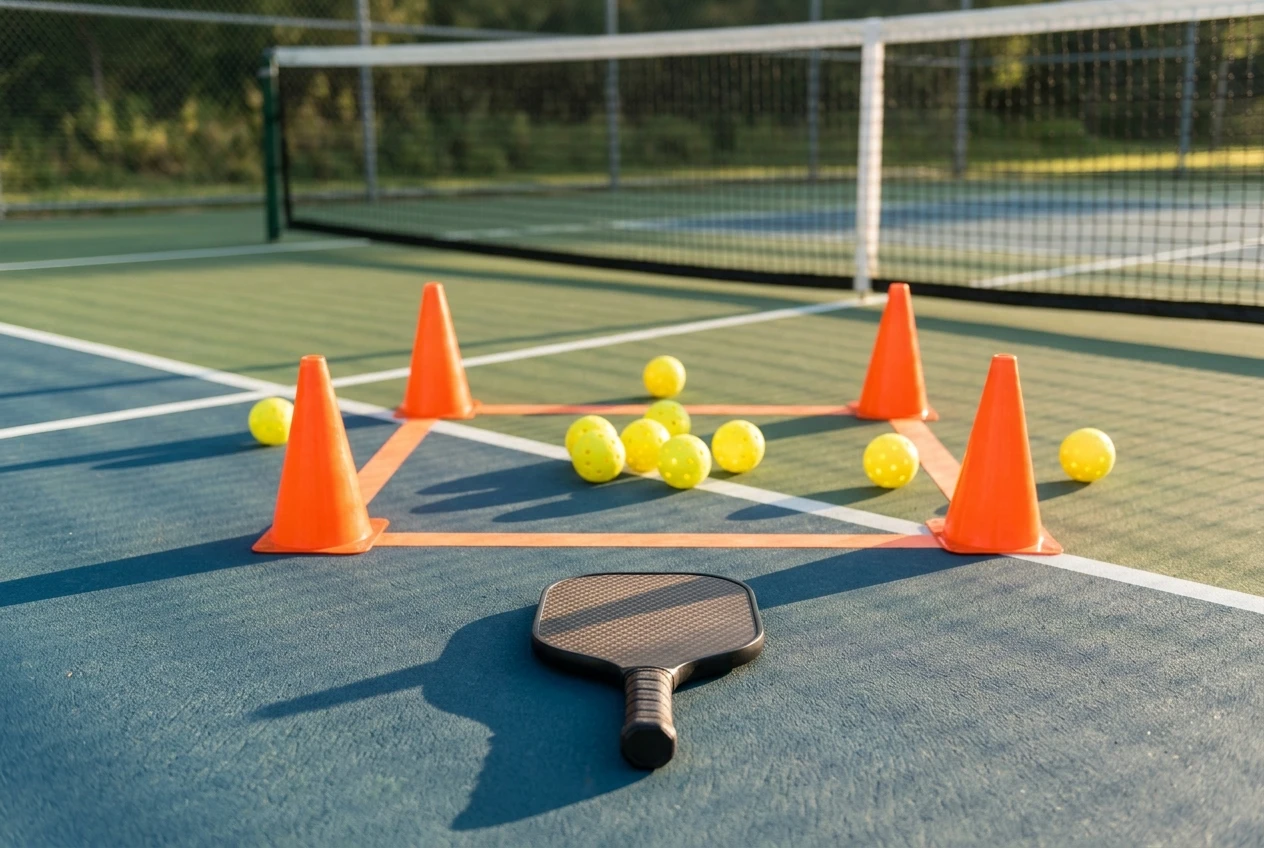
In target box training, place the targets as usual and decide how many balls in a row you need to land in the box. Set the number at a level that takes real effort. If you miss, the count goes back to zero. Over a session, you will notice the moment your attention changes as you approach the end of a streak. That moment is the one you want to practice, because it feels like game point.
You can add a second layer: finish the streak before you are allowed to leave the court, or before you start your match play. A small, real stake is enough.
Dinking drills with a score
Take any dinking drill and turn it into a contest. Play a dink-only game to 11 with a partner, where an unforced error loses the point, or a cooperative rally where you must hit a set number of dinks in a row before the pair can end the drill. If you practice alone or with a partner at a similar level, keep a running score across sessions so you are trying to beat your own number.
Whatever format you choose, keep these rules in place:
- Write down the target before you start, so you cannot lower it halfway through.
- Keep the same breathing and routine steps between attempts that you will use in a match.
- Count misses honestly. A drill with generous scoring does not create pressure.
Practice-game rules that make every point matter
Regular games to 11 allow you to coast. Some points feel unimportant, especially when you are far ahead or far behind. Altering the rules of practice games fixes that.
- Start from a close score. Begin games at 8-8 or 9-9. Every point immediately matters, and you get many more repetitions of late-game situations than a normal game gives you.
- Start from a deficit. Give one side a head start of three or four points and have the trailing team play out the comeback. The leading team practices closing out a game, which is a separate skill that many players find difficult.
- One serve, no redo. Play every serve as if there are no second chances. A fault loses the point, and nobody calls “let’s replay it.”
- Call your own lines and state the score clearly. Saying the score aloud before each serve, as you would in a match, adds a small amount of formality that brings the mood closer to a real event.
- Stakes among friends. The loser of a game takes on a small chore, such as collecting balls or carrying the net. The stake does not have to be large to change how you play.
- Pressure points. Pick specific moments, such as break points on your serve or the point after a long rally, and play them under a stricter rule, for example no unforced errors allowed on the third shot.
Play these formats with the same routine you will use on tournament day. The goal is to see whether the routine holds when the points feel important.
Breathing and reset cues for the 10 seconds you actually have
Between points you do not have long. Rules generally give the serving side about ten seconds after the score is called, so check the rules for your specific event. A breathing practice that needs a minute of quiet will not work here. You need something small enough to fit inside that gap.
Try this one-breath reset:
- Let your shoulders drop as you exhale through your mouth.
- Breathe in through your nose for a count of about four.
- Breathe out slowly for a count of about six.
- Loosen your grip on the paddle by about one notch as you exhale.
A longer exhale tends to slow your heart rate, and releasing grip pressure directly protects your touch on dinks and drops. If you can do only one thing, relax the grip.
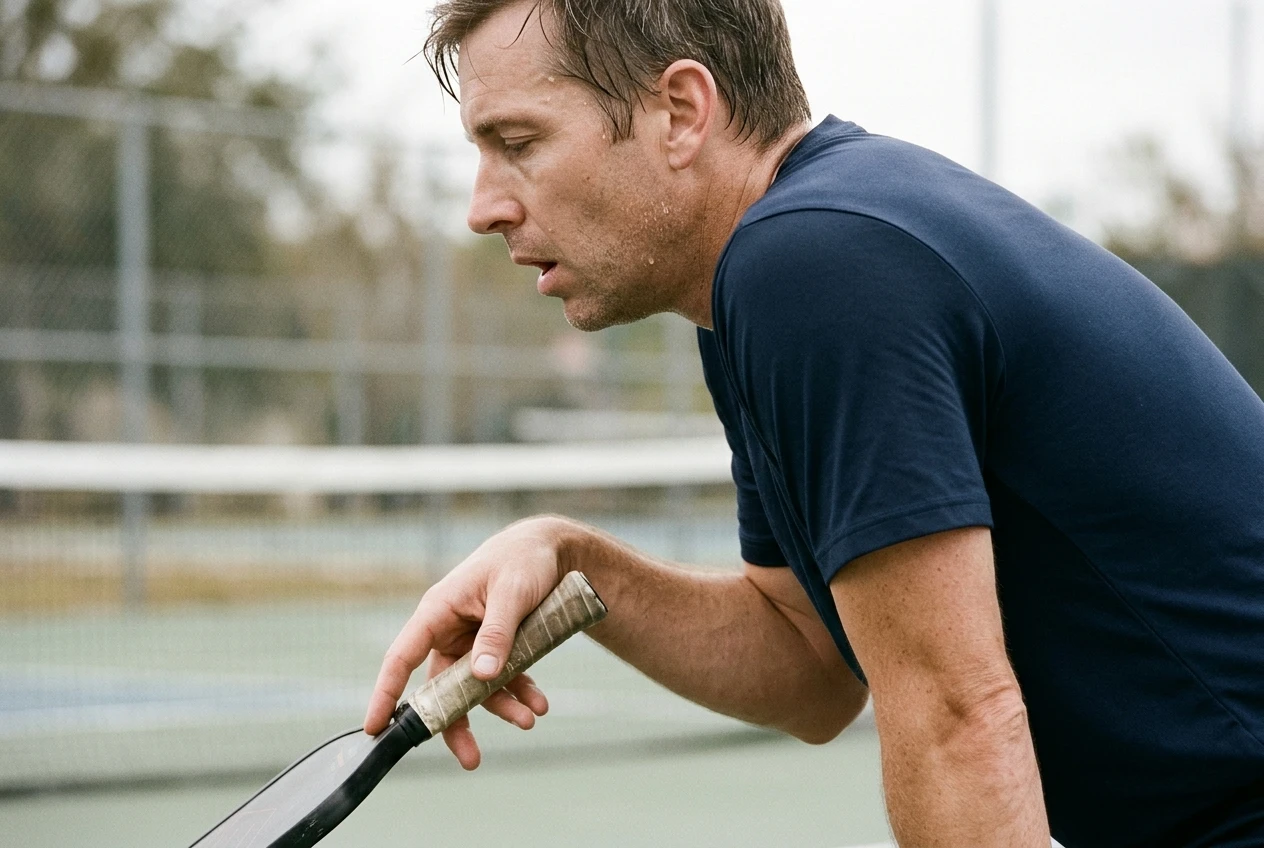
Pair the breath with a short verbal cue that you say silently. Choose words that point to an action and not a result. “Soft hands,” “split step,” “reset” and “next ball” all work. Cues such as “don’t miss” or “stay calm” name the thing you are trying to avoid, and they are harder to follow.
Practice the breath and cue in the same places each time: after a lost point, before every serve, and at each changeover. Over a few weeks these become automatic, which is what you need when the pressure is highest.
Review your head, not just your shots: a post-match mental log
Most players review a match by recalling which shots failed. That tells you what happened but not why. Add a short mental log, written within an hour of finishing, while the match is still fresh. It should take five minutes at most.
Record these items:
- Focus rating. Score your focus from 1 to 5 for the start, middle and end of the match.
- Tightening moments. Note the score when you first felt tense and what was happening, such as a missed serve, a close line call, or a long rally.
- Routine check. Write down whether you ran your between-point routine and when you skipped it.
- Self-talk. Write the actual sentences you remember thinking after errors.
- One adjustment. Choose a single change for your next match or practice session.
After four or five entries, look for patterns. You may find that your focus drops at the same point in every match, or that you skip the routine after bad calls. Those patterns tell you what to train next. A general note such as “I got nervous” will not.
Keep the log short and factual. It is a record of conditions, and it should not become a place to criticize yourself. If you also play practice matches, log those as well, so you can compare how you handle pressure in different settings.
A four-week plan to take into your next tournament
This plan assumes you play or drill three to four times per week. Adjust it if you play less, but keep the order of the weeks.
Week 1: Install the routine
- Use the four-part between-point routine in every practice game.
- Practice the one-breath reset before each serve.
- Start the mental log after every session, even short ones.
- Do not add pressure drills yet. The goal is to make the routine familiar.
Week 2: Add pressure to drills
- Run target and dinking drills with a streak requirement or a score and a written target.
- Keep the routine going between attempts.
- Add one practice game per week that starts at 8-8.
- In your log, note when you felt tension in the drills and compare it with match tension.
Week 3: Raise the stakes in games
- Use deficit starts, no-redo serves and small stakes in most practice games.
- Say the score aloud before every serve.
- If possible, play a practice match against someone you do not usually play, or at a different court.
- Use your log to pick one weak point, such as the moment after a bad call, and focus the week on handling it.
Week 4: Taper and rehearse
- Cut back volume slightly and play games that resemble the tournament format.
- Run the full routine, breathing cue and score-calling in every game.
- Review your log for the last three weeks and write a short list of your own cues and rules for tournament day.
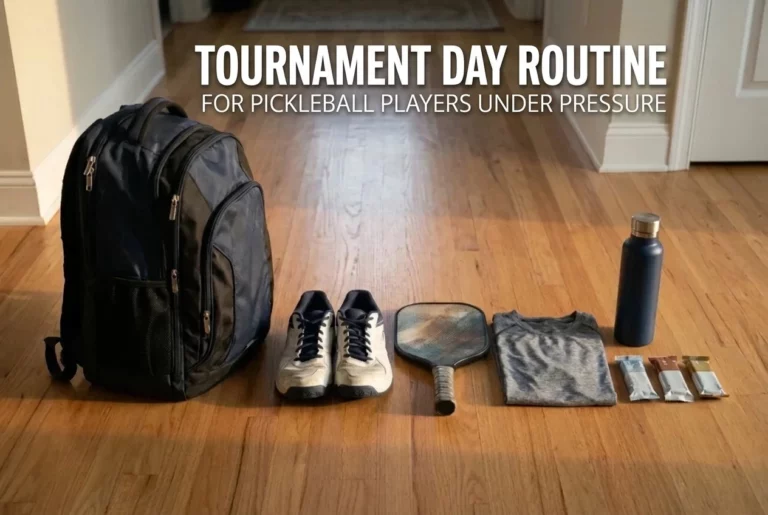
- Prepare your gear and logistics early using the tournament bag checklist, so packing and travel questions do not use up attention you want for matches.
Even with this preparation, some matches will go badly. When you are already trailing, use the approach in how to stay steady when you’re down 8-3. It covers the in-match side that this plan does not.
Mental toughness in pickleball is built from repetition under mild pressure, the same way a dink is built from repetition. Four weeks of routine, pressure drills and honest review will not remove nerves, but they will give you a set of actions to rely on when the nerves arrive.