Most pickleball players watch their shot until it crosses the net. That habit costs them rallies. The half second after contact decides whether you are ready for the next ball or already reaching for it, and that is when most players stop moving.
This pickleball footwork drills gives you an order of operations for that half second: a balanced finish, a recovery step, a split step timed to your opponent’s paddle, and then a read and a move. It also covers how to share court space with your partner, three pickleball footwork drills you can run with one other person, and the habits that keep players a step late. It is written for doubles, where the gaps are narrower and the ball comes back faster than most recreational players expect.
Why you lose rallies after the shot, not during it
Think back to the last point you lost by getting to the ball late. The mistake probably did not happen on your swing. It happened between your shot and the opponent’s reply, when you stood still, drifted, or moved in a way that did not prepare you for the return.
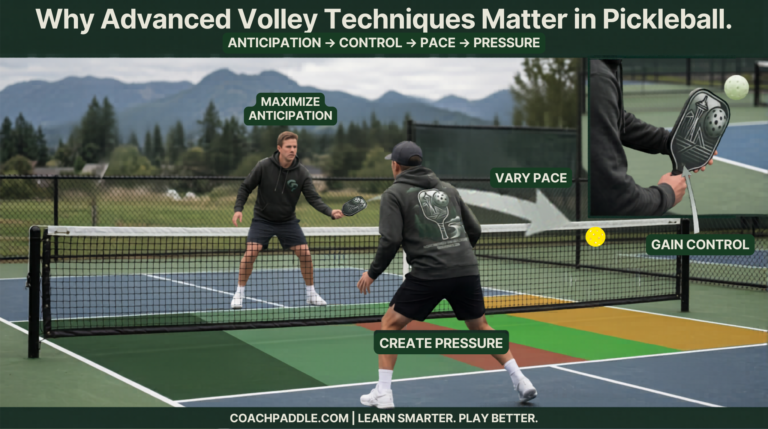
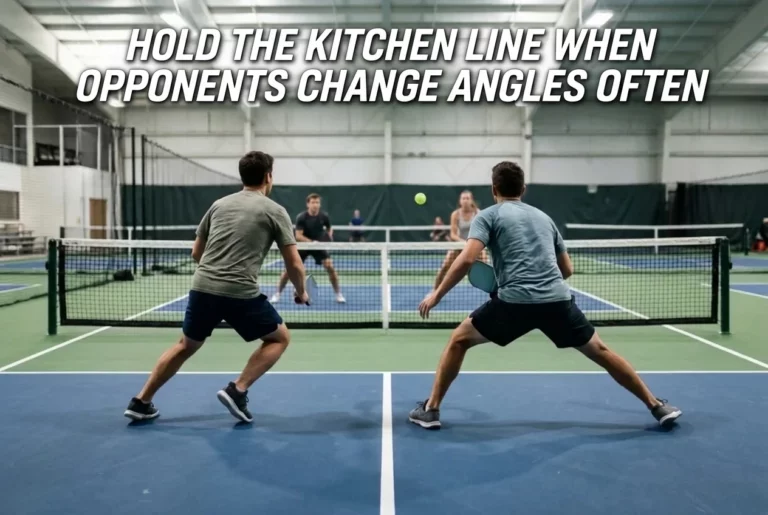
Doubles gives you very little time. At the kitchen line, both teams stand close enough that a volley can come back before you have finished admiring your own dink. A player who spends that time watching the ball has used up most of the time they had to reposition.
Players also tend to treat footwork as something that happens before the shot: get to the ball, then hit it. That is half of it. The other half is leaving the shot in a position that makes the next one easy. If you finish off balance, you spend the next ball recovering instead of preparing, and that is how a single late shot turns into a string of rushed ones.
The sequence to work toward looks like this:
- Hit from a balanced position and hold your finish briefly.
- Take small recovery steps toward the spot your opponent’s best reply will come from.
- Split step as your opponent makes contact.
- Read the ball and push off in the right direction.
- Hit again from a balanced position.
Every section below covers one link in that chain. Footwork drills only help if you know which link is failing, so read with your own last few games in mind.
The split step: timing it to your opponent’s contact, not the ball bounce
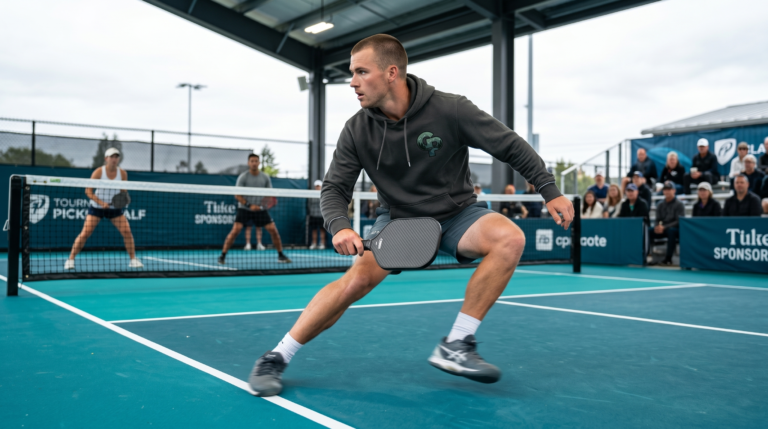
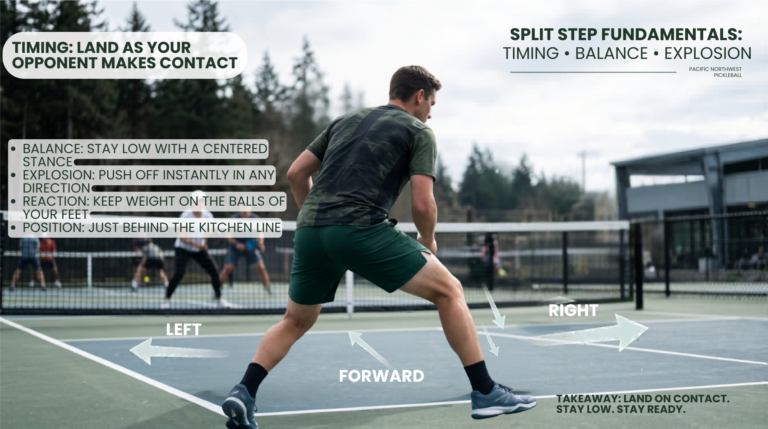
A split step is a small hop or weight drop that lands with your feet slightly wider than your shoulders, on the balls of your feet, with your knees soft. Landing in that position lets you push off in any direction. Without it, one foot is usually carrying your weight, and you have to shift before you can move.
The timing is where most players go wrong. Many wait for the ball to bounce, then hop. In doubles that is too late for two reasons. First, a lot of the ball traffic at the kitchen is volleyed and never bounces on your side before you have to play it. Second, by the time the bounce arrives, you already needed to be moving toward the ball.
Time your landing to your opponent’s contact instead. As their paddle meets the ball, your feet should be landing. The hop happens just before that moment, so you start it as they swing forward. That gives you the information the ball has not yet shown you, and you leave the ground with the ball still on their side.
A few details make the split step work:
- Keep the hop small. A tall jump keeps you in the air longer and makes you land after the ball has left their paddle. A low hop is quicker and easier to repeat on every shot.
- Land, then go. The split step is a loading position. The push off the landing foot is what carries you toward the ball. If you land and then stand there, you have only taken an extra step.
- Use it every time. Players often split step at the baseline during serves and forget it at the kitchen. The kitchen line is where the most shots arrive, and it is where the split step helps most.
- Slow down if you cannot land in time. If you are still running when your opponent hits, you cannot split step. Shorten your last two or three steps so you can land as they make contact, even if that means arriving a little less far forward.
Watch your opponent’s paddle and body rather than the ball. The paddle face, the shoulder turn and the position of their feet tell you more about where the ball is going than the ball does in flight.
Recovery steps: the small adjustments that beat big sprints
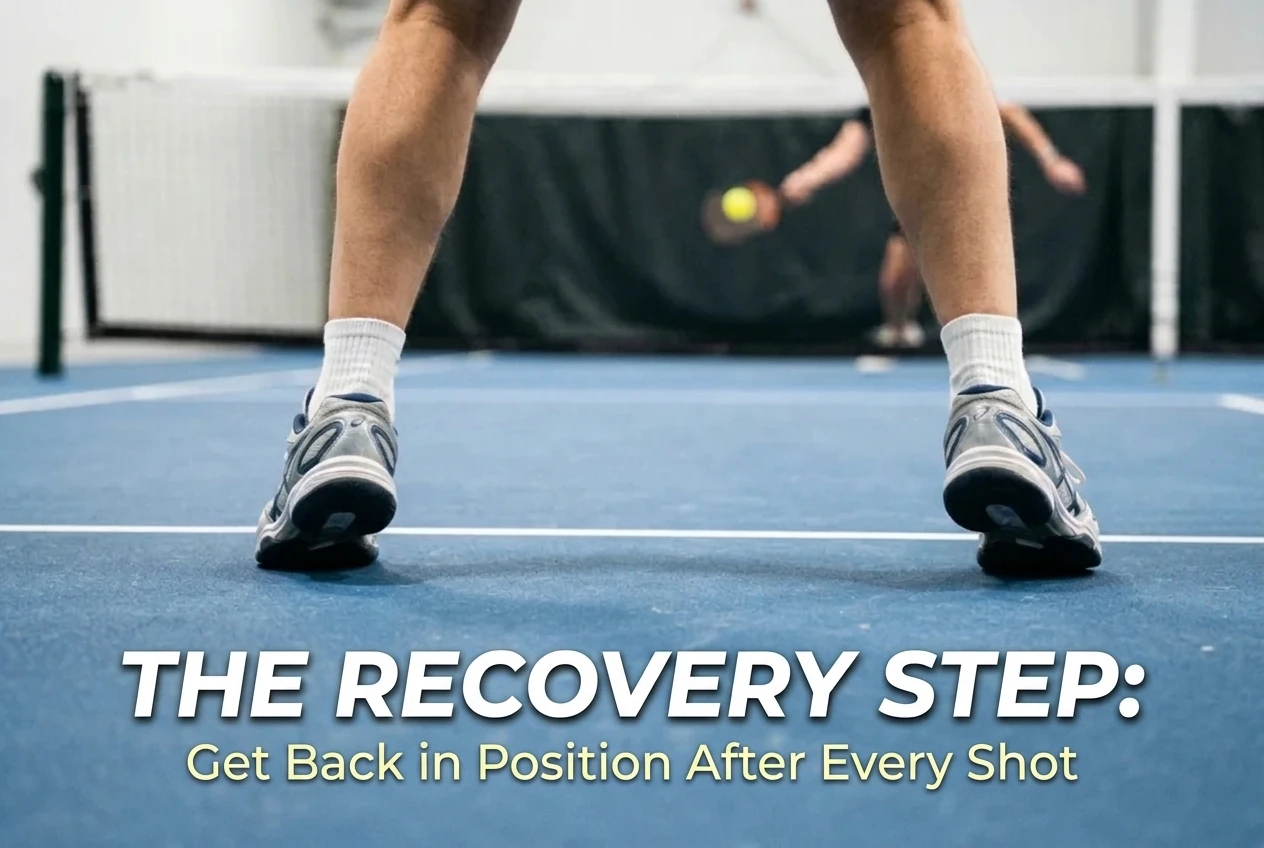
After you hit, your goal is to reach a position where you can cover your opponent’s most likely replies, not to run back to a fixed spot. The recovery step is the first short movement that starts that process, ideally before your follow-through has finished.
Players who recover with one big sprint tend to arrive in the right area while still moving, which means they cannot split step. Players who recover with two or three short steps arrive in the same area balanced. The second group tends to look slower and get to more balls.
Where you recover to depends on the shot you hit. If you dink cross-court, your opponent’s easiest replies are another cross-court dink or a straight-ahead dink down the line. The middle of those two options is where you want to be, not the center of the court. If you hit down the line, the cross-court reply is typically the one that stretches you, so you shade toward it.
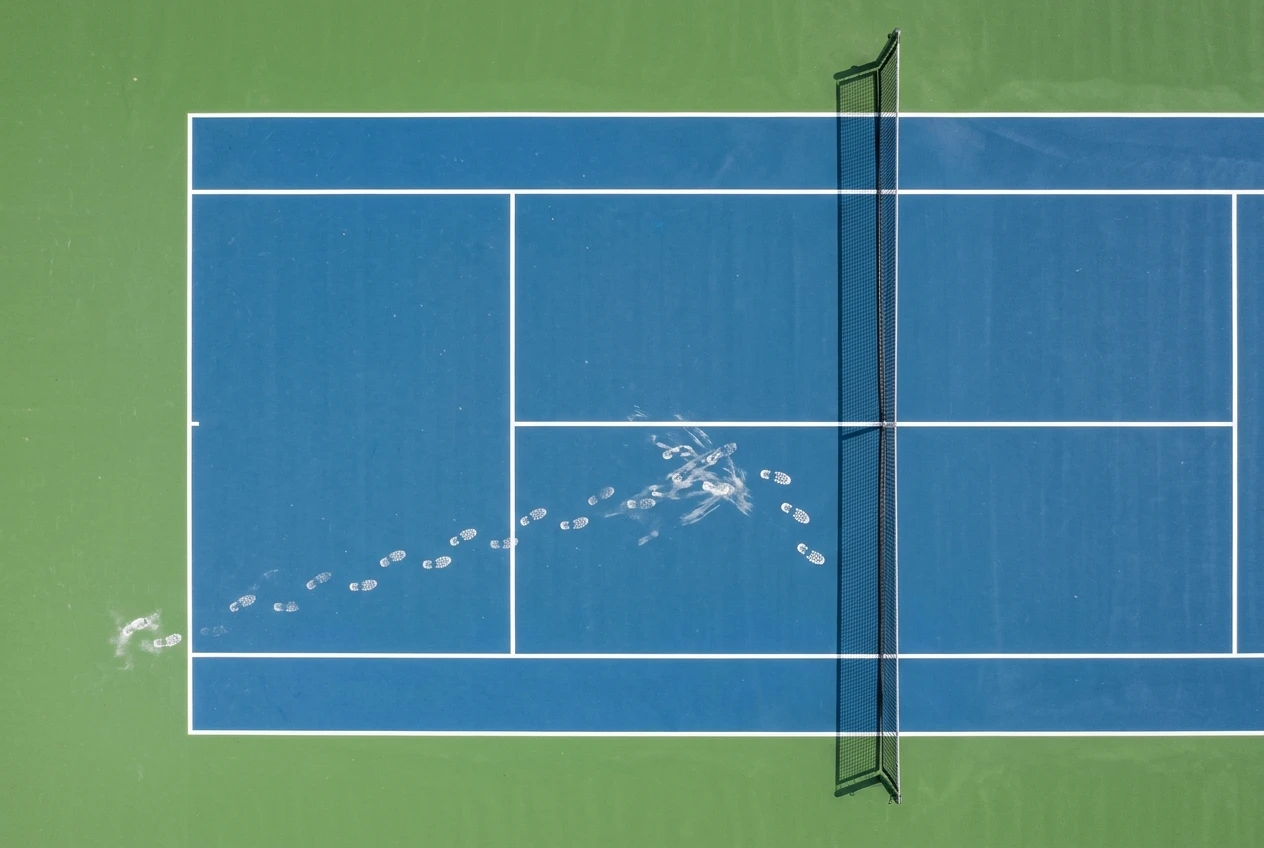
This is also where a third shot drop gets its value. After the drop, you are walking forward from the baseline toward the kitchen. If the ball is popping up on your drops, fixing the drop itself gives you a better chance of moving forward in time, because a ball that sits low gives you a few extra steps of approach.
Some habits that make recovery steps efficient:
- Push off your outside foot. After a wide reach, your outside foot is usually loaded. Use it to push yourself back toward the middle rather than dragging your inside foot across.
- Keep your feet from crossing. Short shuffle steps keep your base wide. Crossing your feet for a recovery step leaves you on one leg at the moment you want to be split stepping.
- Move while your paddle returns. Bring the paddle back to the ready position in front of your chest as you take the recovery step, so the paddle and feet reset together.
- Recover even after winners. A shot that looks like a winner sometimes comes back. A small recovery step costs nothing and keeps you ready if it does.
The aim is to reduce the distance you have to cover in the next phase. A short recovery step before the split step usually saves more time than any amount of extra speed afterward.
Balance checkpoints: where your weight, knees and paddle should be at contact
Recovery is only possible if you finish in a position you can recover from. Hitting while off balance, leaning, reaching or falling forward, makes every later step slower. These checkpoints give you something concrete to look at in video of yourself or to ask a partner to watch.
Weight. At contact, your weight should sit on the balls of your feet, slightly forward, and be spread between both feet rather than stuck on one heel. If your heels are down and your weight is back, you will need an extra step to start moving forward after the shot.
Knees. Your knees should be bent enough that you could jump without first dropping lower. Bending at the knees instead of the waist keeps your head level and lets you change direction faster. Standing tall on straight legs makes low balls awkward and recovery slower.
Head and chest. Your head should stay relatively still through contact, with your chest roughly above your knees. A head that dips or lunges ahead of the paddle usually means your feet did not get you close enough to the ball.
Paddle. Contact should happen in front of your body, with the paddle face visible in your peripheral vision. A ball that gets behind you forces a reach, and reaching is the most common reason players lose balance on defense. After contact, your paddle should come back to the ready position quickly, not hang out wide or low.
The finish. Try holding your finish for one beat after each shot in practice. If you can hold it, you were balanced. If you have to take a catch-up step to avoid falling, you were either too far from the ball when you hit it or you reached instead of moving your feet. Both problems start with the step before the shot, not the shot itself.
A useful self-check: after a defensive shot, can you take a recovery step in either direction? If you can only move one way because your weight is committed, you finished too far over your front foot or too wide.
Moving with your partner: shifting and covering the middle without crowding
Doubles footwork is shared. Two players who each recover well but do not coordinate still leave gaps, and the biggest gap is almost always the middle.
The basic principle is that you and your partner shift together toward the side the ball is on. If your opponent hits to your left side, you both slide slightly left. The player nearer the ball covers the shot and the other covers the middle behind them. When the ball moves back to the other side, you slide back as a pair.
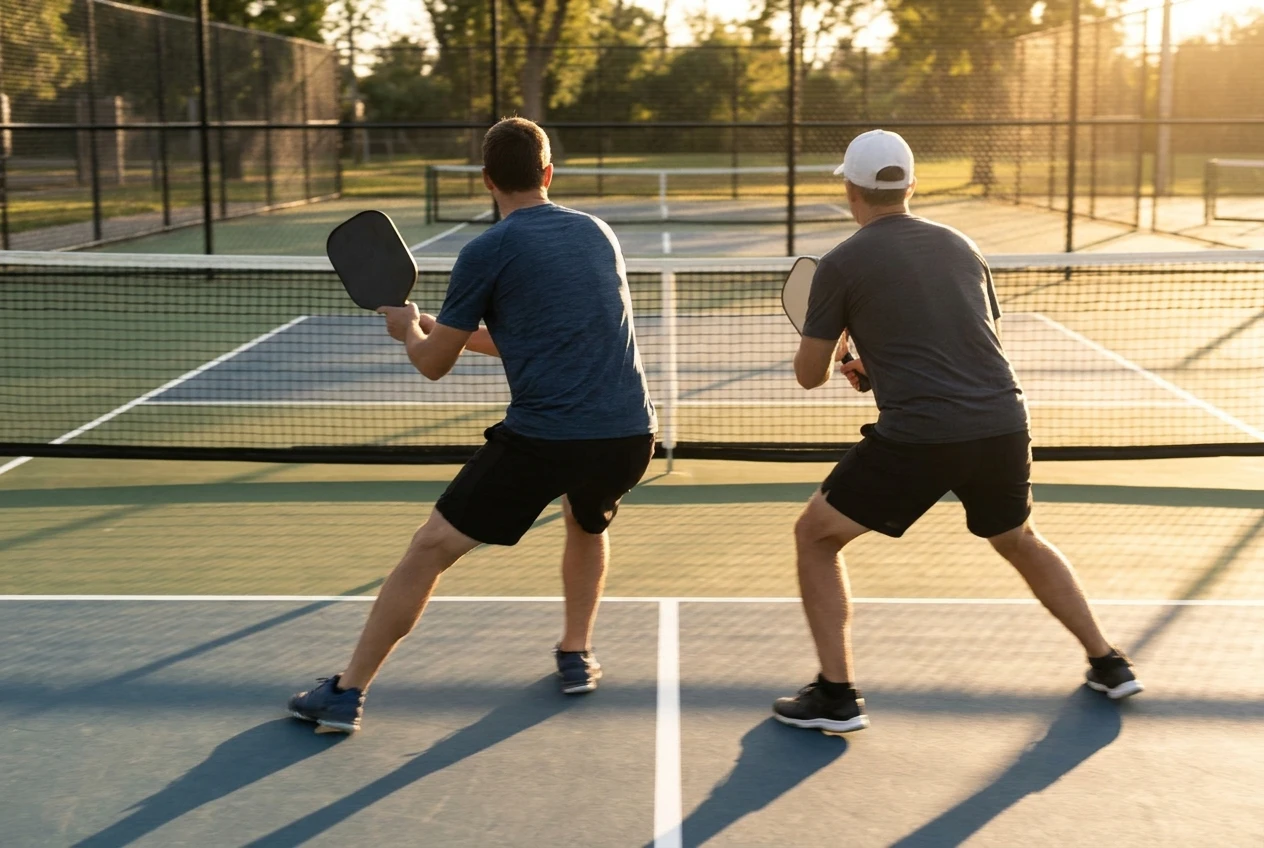
The distance between you matters. If you stand too far apart, the middle opens. If you stand too close, you tangle paddles and block each other’s swing. A workable rule of thumb is to keep enough space that both of you can swing freely, roughly an arm and a paddle apart, and adjust from there as you see where balls land.
A few habits help partners stay organized:
- Agree on a middle rule before you play. A common arrangement is that the forehand takes balls down the middle, since the forehand is typically the stronger shot. Whatever you choose, state it once so you are not deciding in the middle of a rally.
- Call early. “Mine” or “yours” called while the ball is still on the opponent’s side gives your partner time to react. A call that comes after the bounce is almost always too late.
- Move after your partner’s shot, not just your own. When your partner hits, you should be taking recovery and shifting steps too. Standing still while your partner works creates the gaps your opponents aim for.
- Cover for a partner who is out of position. If your partner is pulled wide or back, you need to take more of the court for that rally. If you regularly end up covering the whole court alone, the singles tactics for doubles players piece explains how to manage large areas with fewer steps.
Do not follow a partner step for step, either. If both of you chase the ball to the same side, the opposite side opens. Think of it as a pair of linked positions rather than two independent players.
Three footwork drills you can run with one partner and no equipment
These pickleball footwork drills need two players, paddles, a ball and the court lines. Each one targets one link in the chain: the split step, the recovery step, and moving with a partner. Run them in short blocks, around three to five minutes each, and rest between them so your footwork stays sharp.
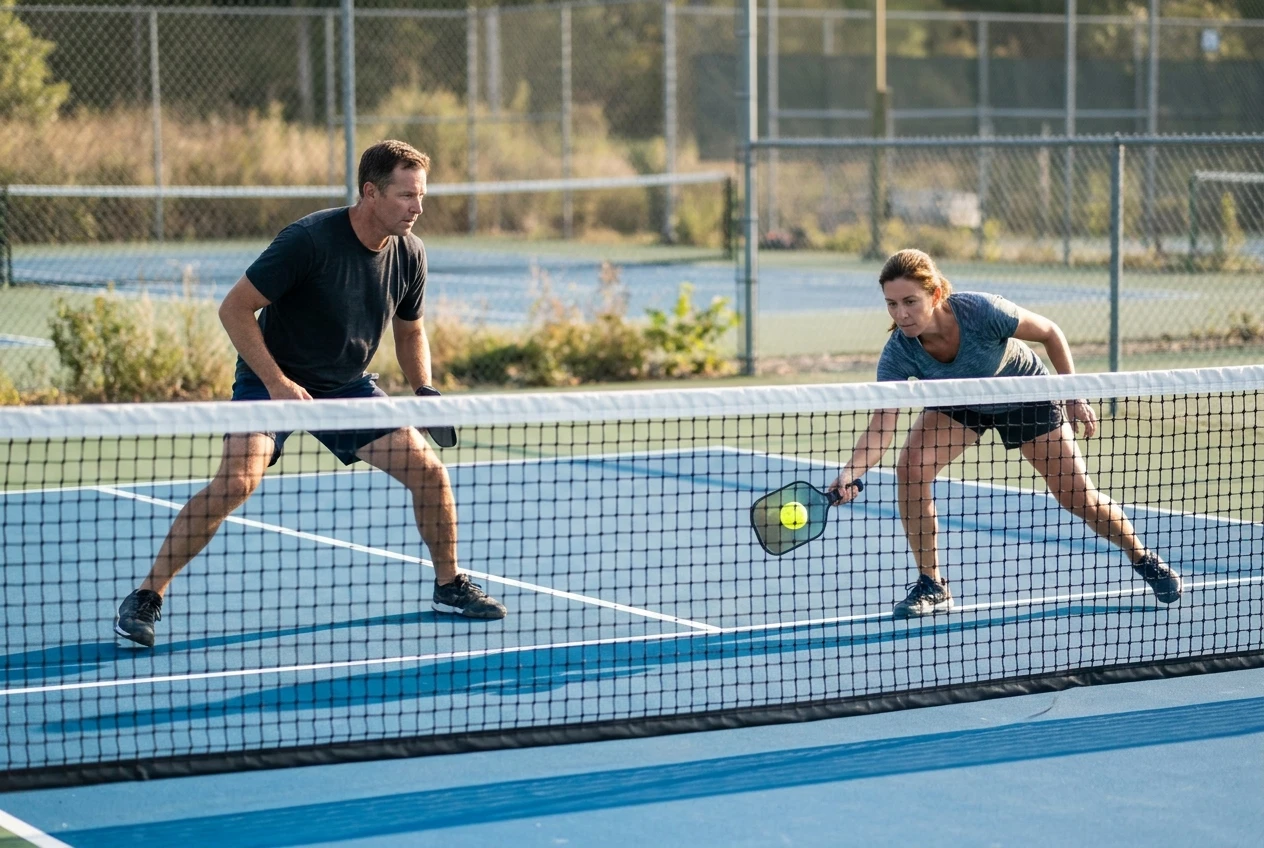
Drill 1: Call the contact
Stand on opposite sides of the net, both at the kitchen line. Start a slow cross-court dink rally. Your only extra job is to say “now” out loud at the moment your partner’s paddle touches the ball, and to land your split step on that word.
Your partner watches your feet. If you land after they have already hit, you are late. Slow the rally down until you are landing on contact consistently, then gradually speed it up. Swap roles after a few minutes. The out-loud call forces you to look at the paddle instead of the ball, which is the habit you are building.
Drill 2: Hit, recover, reset
Your partner stands across the net and feeds balls alternately to your left and right at the kitchen line. After each hit, you take a recovery step back toward the middle of the angle you just hit, and your partner does not feed the next ball until you are there and balanced.
Start with your partner waiting. Once you are consistently balanced before each feed, shorten the pause. The pause is the part to shrink slowly, because it measures how much time your recovery actually takes. If you start missing balls or reaching, lengthen the pause again. You are done when you can recover and split step before a feed arriving at a normal rally pace.
Drill 3: Shadow shift
This one needs no ball. You and your partner stand side by side on the same side of the net, at the kitchen line. One of you calls “left,” “right,” “middle” or “back,” as if an opponent had hit the ball there. Both of you shift together, the player nearer the ball takes a shadow swing, and the other covers the middle.
Agree on your middle rule first and test it. After the shadow swing, both players take a recovery step and a split step and hold the position until the next call. Swap the caller every minute. Because it uses no ball, you can repeat it many times quickly and spot where you tend to crowd or leave a gap.
If you want a ball added once the shadow version feels automatic, you can ask a third player to feed from across the net. The shadow version is useful on its own for locking in how you and your partner share space.
Common footwork habits that keep you a step late
Recognizing a habit is half of fixing it. These are the patterns that most often leave recreational players half a step behind, and each one connects to a link in the chain above. The common pickleball mistakes piece covers errors beyond footwork if you want a wider list.
- Watching your shot land. If your eyes follow the ball to the other side, your feet usually stop. Look at your opponent’s paddle after you hit.
- Splitting on the bounce. If your hop happens after the ball hits the ground, you are reacting to information that arrived too late. Time it to their contact.
- Hopping too high. A tall jump lands late and rocks you back on your heels. Keep it low and quick.
- Sprinting to recover. Large steps arrive with momentum and no balance. Use two or three short ones.
- Recovering to a fixed spot. Going back to the same place every time ignores where you just hit. Shade toward the replies your last shot allows.
- Reaching instead of stepping. Extending your arm past your body to save a step costs balance and recovery time. Take the step.
- Hitting the ball behind your body. Late contact forces awkward swings. Move your feet until the ball is in front of you.
- Standing still while your partner hits. The player not hitting still has steps to take. Shift with the ball.
- Drifting into your partner’s space. Following the ball into the same lane leaves the other side open. Keep your arm-and-paddle spacing.
- Crossing your feet on lateral moves. It narrows your base and makes the next change of direction slow. If you notice slipping on side-to-side moves, the problem may be traction as well as technique.
Pick one or two of these rather than trying to correct everything in one session. The most common cause is usually the first one on the list, because it comes before every other step.
Put it into practice
Pick one of the three drills and run it for ten minutes at your next session. Afterward, go back through the habits in the last section and note which one you caught yourself doing during regular games. That habit is your next thing to work on.
If you notice your feet sliding on side-to-side moves, your shoes may be part of the problem. The guide to choosing pickleball shoes that protect your ankles explains what to look for in lateral support so your recovery steps have something solid to push against.