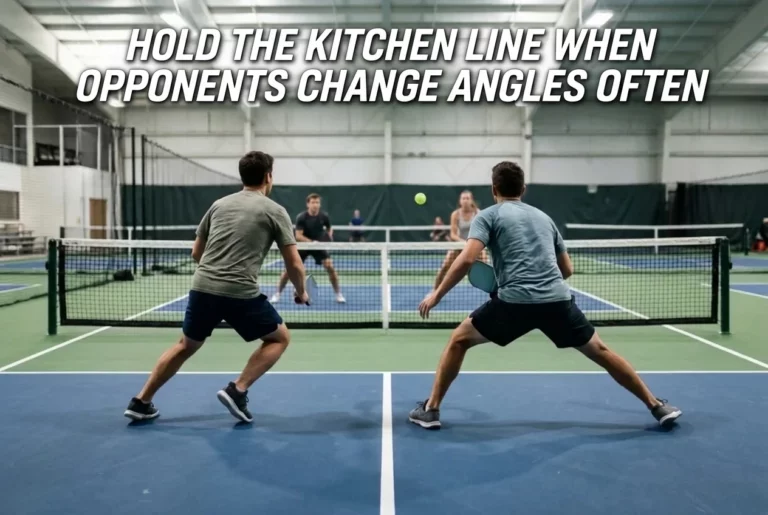
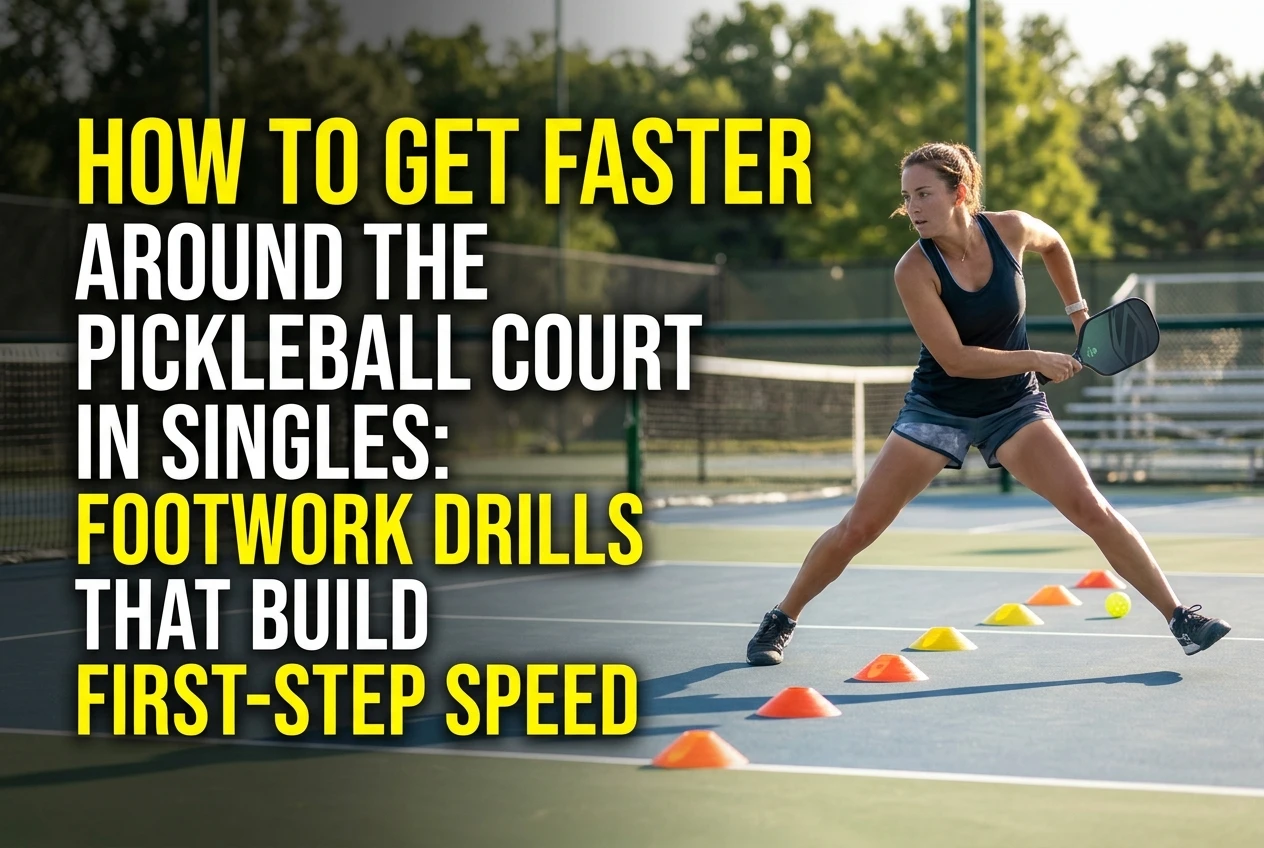
Singles on a 20-by-44-foot court means one player covers the ground that two share in doubles. Most advice on how to improve court speed in pickleball singles is “get fitter” or “run sprints,” and fitness does help. But on a pickleball court the longest dash is only a few steps, so top running speed rarely decides whether you reach the ball. Court speed comes down to three things: a first step that starts on time, a split step that prepares you before the opponent hits, and fewer wasted steps between shots.
This article covers how to physically get to the ball and get back. For where to stand and what to hit, see the singles tactics guide for doubles players. Here the subject is movement, with a drill progression you can run on a single court.
Why singles speed is mostly the first two steps, not top speed
Look at the distances. From the middle of the baseline, a ball hit wide is a few feet away. A drop landing near the kitchen line is roughly 15 feet from the baseline, and a player covering that in a full sprint would still be taking only a handful of strides. Nearly every ball in a singles rally is reached in one to four steps.
That changes what you should train. In a four-step run, the first step sets the direction and the second builds momentum. If the first step is slow, points in the wrong direction, or comes after you have already watched the ball cross the net, nothing later makes up the difference. A player with average sprint speed and a prepared first step often looks faster than a fit player who starts from a standstill.
It also explains why doubles players feel late in singles. In doubles you stand closer to the net with a partner covering half the width, so your habits are built around small adjustments. In singles the same habits leave you reaching, lunging, and hitting off balance. The fix is to make the start of each movement quicker and cleaner, then reduce the steps you take after it.
Three skills carry most of the improvement:
- A split step timed to your opponent’s contact
- A first step that pushes off the outside foot instead of reaching with the near foot
- A recovery that returns you to a balanced central spot before the next shot
The split step: timing it so you load before your opponent hits
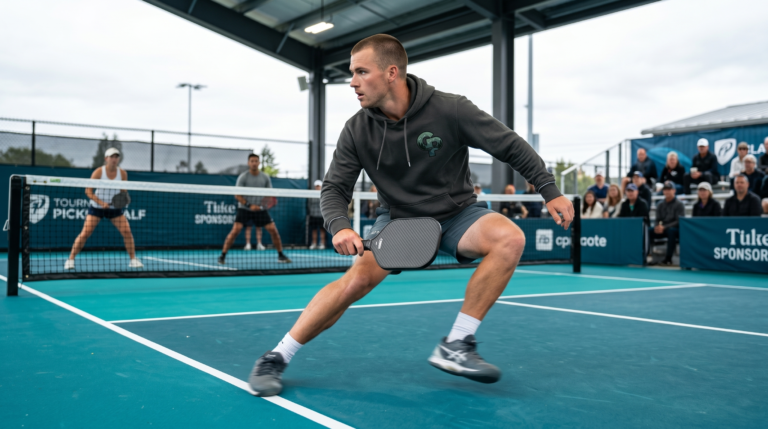
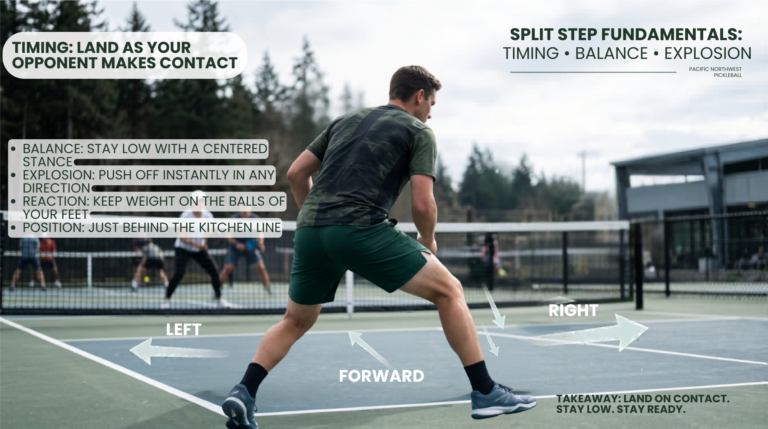
A split step is a small hop, or a quick drop of the hips, that lands with both feet roughly shoulder-width apart or slightly wider. It lets you push in any direction right away. Standing flat-footed, you have to shift weight before you can move. Mid-stride, you carry momentum in whatever direction you were already going.
The timing matters more than the size of the hop. Land as your opponent’s paddle meets the ball, not after the ball is on its way. If you land late, you are still in the air or just touching down when you needed to be pushing. If you land early, you have stopped and gone flat again by the time the ball is hit. The common cue is “land on contact”: you start the hop as your opponent swings forward, and your feet touch down as the paddle meets the ball.
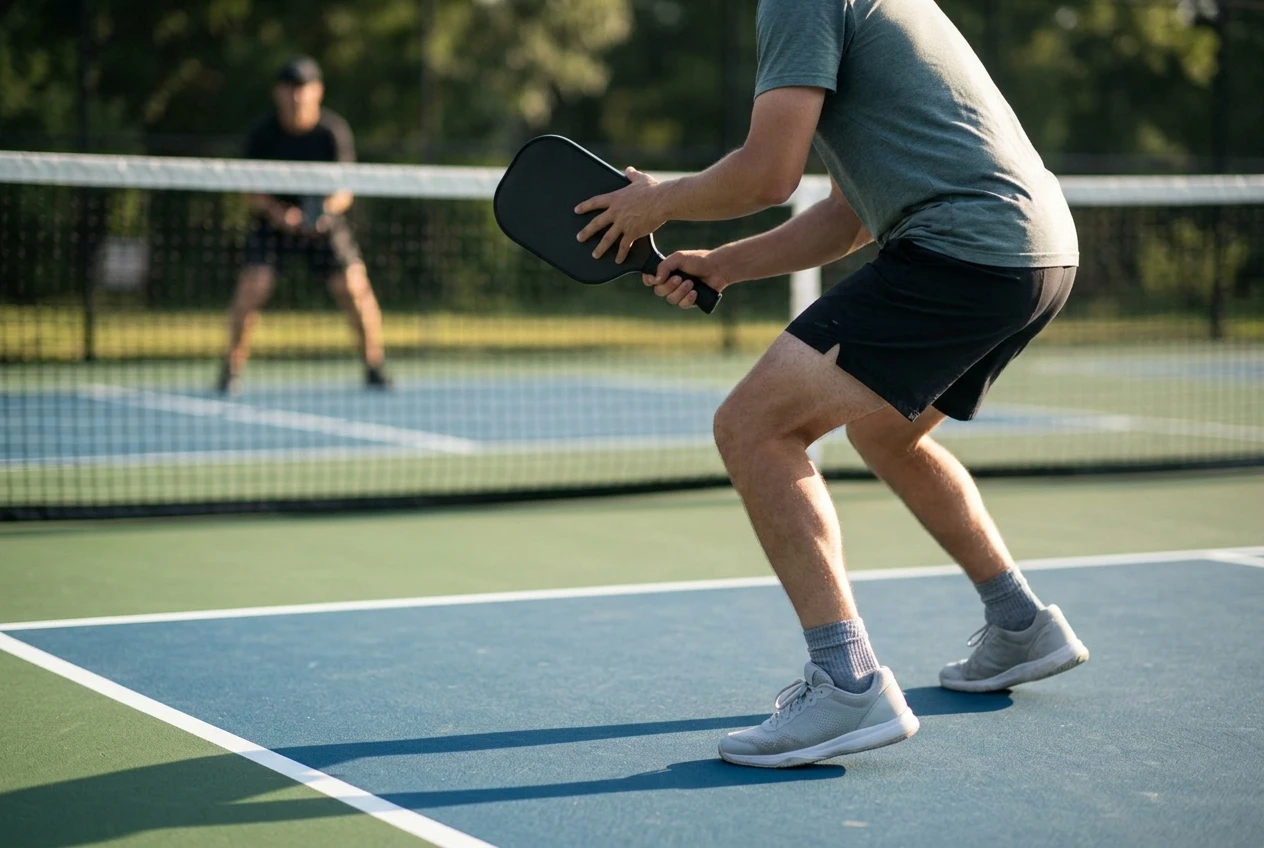
A few details make it work better:
- Keep it low and quiet. A big, bouncy hop wastes time in the air.
- Land on the balls of your feet with knees bent and weight slightly forward.
- Keep your paddle up in front of you so your hands are ready as your feet are.
- Split step after every shot you watch your opponent hit, including the ones you expect to be easy.
Once you land, read the ball. The direction of the paddle face and the swing path tell you early where the ball is heading. Your job is to have your feet ready so that when you read it, you can act on it immediately.
Push, don’t reach: first-step mechanics for lateral and diagonal balls
A common mistake is stepping toward the ball with the near foot and stretching. It feels like you are moving, but your weight stays over your original spot and your body has to catch up. The faster pattern is to push off the foot on the far side from the ball.
For a ball to your right, push hard off your left foot so your body is driven to the right, and let the right foot step to catch it. For a ball to your left, push off the right foot. Your hips and chest point where you are going, and the pushing leg does the work.
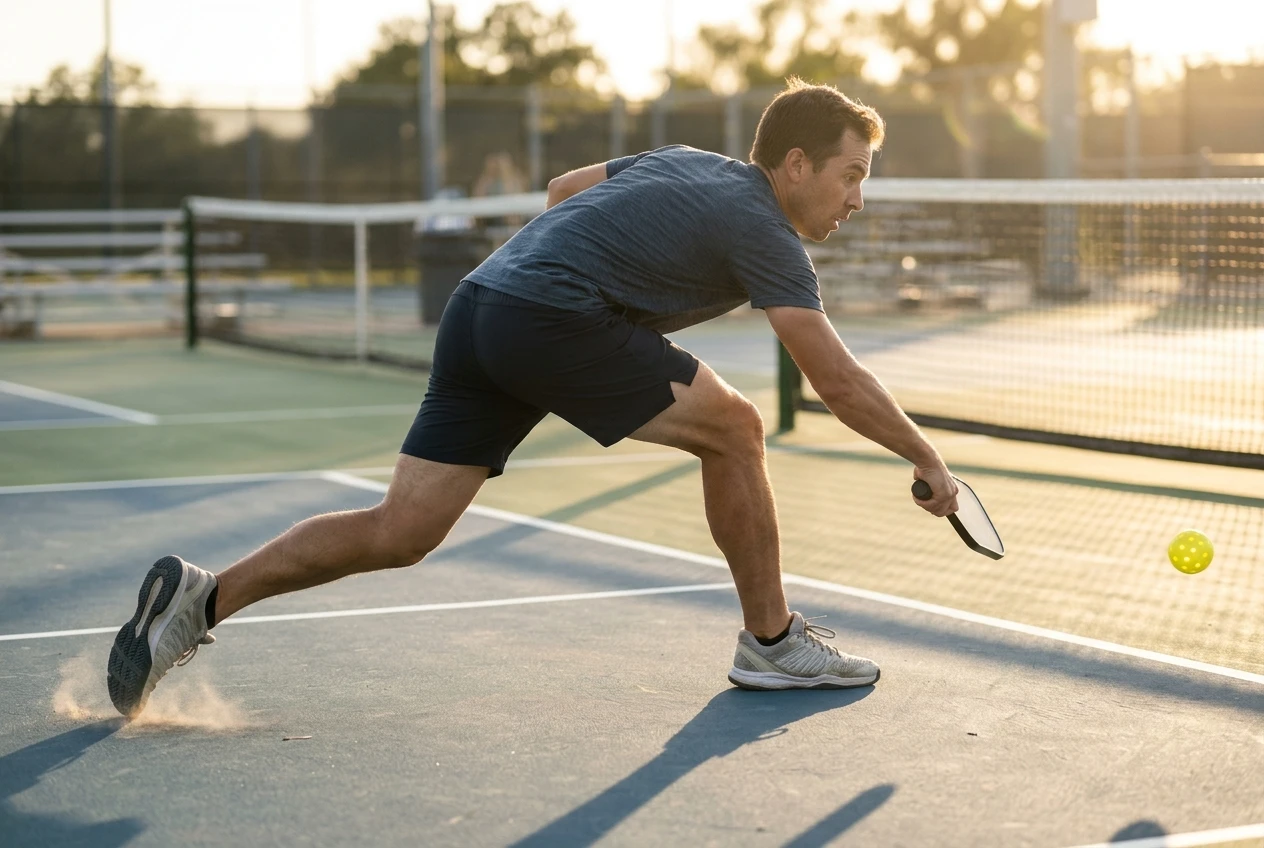
For diagonal balls, the first move is a turn. Pivot on the foot closest to the direction you are heading so your toes and hips point toward the ball’s path. Then take your first push step. Players who try to run diagonally while still facing the net tend to cross their feet or take choppy side-shuffles that cost half a step.
Some practical points:
- Keep your first step short and quick instead of long and loud. A long first step slows the second.
- Stay low. If your head rises as you start, your push loses force.
- Use side shuffles for short lateral distances and a turn-and-run for anything beyond about two steps.
- Finish with a stable base before you swing, even if it is a quick one. Hitting on the move is fine when you are balanced. Hitting while falling sideways is what produces errors.
Closing the gap forward and retreating on a lob without crossing your feet
Short balls and lobs expose footwork faster than anything else in singles, because they pull you in opposite directions.
Moving forward. When a drop or short ball lands in front of you, take quick, small steps as you approach and break them down near the ball. Make the last two steps shorter so you can stop and control the shot. Rushing in with long strides gives you momentum that you then have to absorb. Many players bump the ball long or pop it up because they arrived too fast to settle.
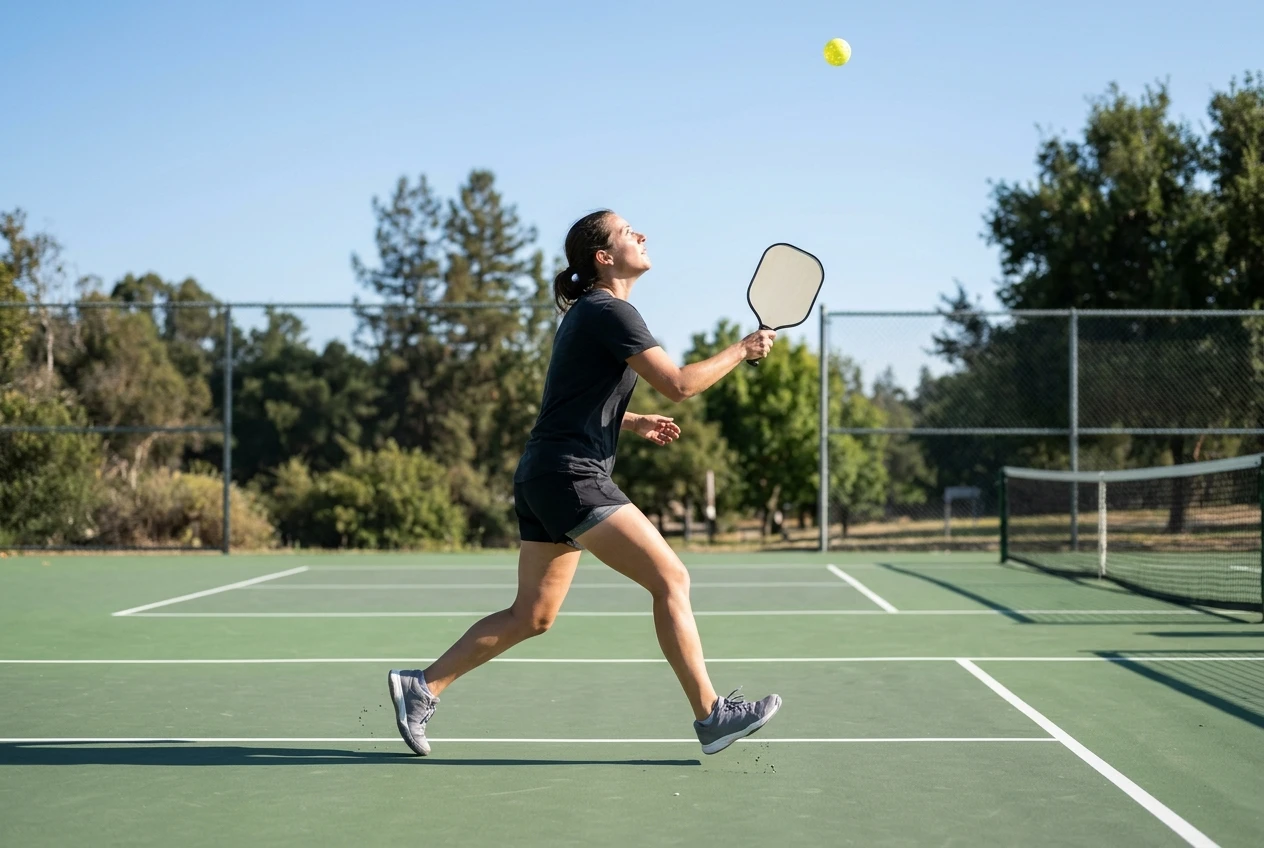
Retreating on a lob. The weak move is to backpedal with your chest facing the net. You can only go a few steps before your stride shortens, and it is easy to trip. The better option is to turn your hips and shoulders sideways, then use a crossover or a side-step-and-turn pattern, depending on the distance. Crossing your feet is not always wrong at speed, but it must be controlled. The problem is crossing when your feet are not ready to land under you. For short retreats of two or three steps, use a sideways shuffle with your head turned to track the ball. For deep lobs, turn and run to a spot behind where the ball will land, then set your feet before you hit.
Choose the retreat by distance, not habit:
- One or two steps back: shuffle sideways, keep facing the ball
- Three or more steps: turn and run, then stop and set
- Ball clearly over your head: turn early. Do not wait to be sure
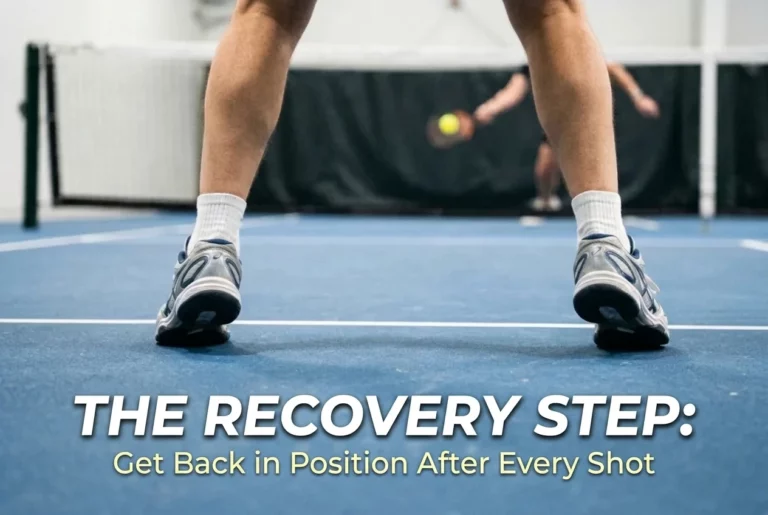
Recovery steps: getting back to center before the next shot
Singles players often lose points by hitting a good shot and then watching it. Recovery begins as soon as the ball leaves your paddle.
The target is a central, balanced position, not a fixed spot. The ideal recovery point shifts with your shot. If you hit cross-court from the left side, your best waiting position moves slightly toward that side, because the return is most likely to come back there. If you hit down the line, you leave more of the other side open, so your recovery needs to cover more distance. This is covered in more detail in the tactics article. The movement point is simple: finish your swing, take your recovery steps, and be in a split step by the time your opponent hits.
To recover well:
- Plant your outside foot after the shot and push back toward the middle instead of drifting.
- Take two or three small, quick steps rather than one big one.
- Keep your eyes on your opponent as you move, not on your own shot.
- If you cannot recover fully, at least be moving in the right direction when you split step.
Most missed recoveries come from slow decisions, not slow legs. Start moving the moment you have hit.
A four-drill footwork progression you can run on one court
You need a partner for the first and last drills, and the middle two work with a partner or a feeder. Each drill builds on the previous one. Do them in order, and stay with a drill until the movement looks tidy before adding speed.
Drill 1: Split and push (lateral). Stand on the baseline center mark. A partner feeds easy balls to your left or right from the other side of the net. Split step as they make contact, push to the ball, hit it back, and return to center. Do 10 feeds per round, 3 rounds, resting between. Focus only on landing on contact and pushing off the far foot.
Drill 2: Diagonal turn and recover. Same setup, but your partner feeds balls to the back corners and the front corners of your side. You must turn, run, set, hit, and recover. Add a rule: after every shot you touch the center line with your foot before the next feed. Do 8 feeds per round, 3 rounds.
Drill 3: Short and deep. Your partner alternates between a short drop and a lob. You move forward for the drop, then backward for the lob, staying controlled in both directions. Because you cannot predict the direction, your split step has to be right. Do 6 to 8 feeds per round, 3 rounds, and choose your retreat pattern by distance.
Drill 4: Recovery rally. Play out points cross-court only, or use a down-the-line then cross-court pattern. After each shot you must reach a marked center spot and split step before your opponent hits, or you lose the point. This adds the pressure of timing. Play to 7 points, then switch.
Run this as a block of 20 to 30 minutes. If your legs are tired before you finish, stop. Sloppy footwork on tired legs trains the wrong habits.
Shadow footwork and solo work when you have no partner
You can practice the movement patterns without a ball or a partner. Shadow footwork removes the hitting and isolates the steps.
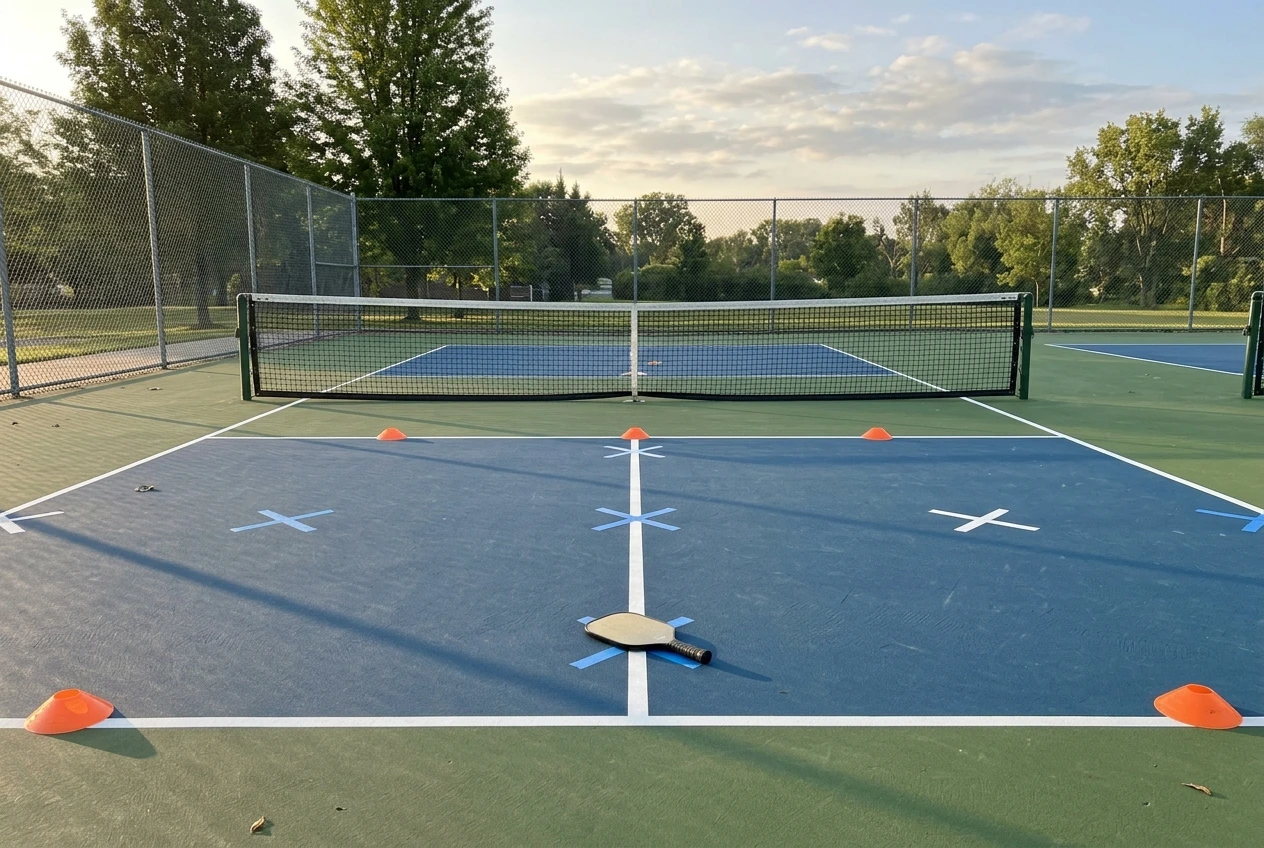
Mark four to six spots on a court with tape, cones, or even a water bottle: a center spot, two side spots, and front and back spots. Then:
- Stand at center in a ready position.
- Call out or randomly choose a spot (a phone timer with random cues works, or a number system you set up).
- Split step, push to the spot, and tap a foot there, mimicking the swing.
- Recover to center and split step again.
Do 30 seconds on, 30 to 60 seconds off, for 6 to 8 rounds. Keep your paddle in hand so the posture matches a real point.
You can also work the split step alone by hopping on contact with a video of a match or while watching a partner hit another court. If you want ball work without a partner, the training aids guide for solo practice covers options that can support this kind of practice.
How to build a weekly speed session around your match schedule and joints
Footwork work is tiring in a particular way: lots of stopping, starting, and changing direction, which loads the ankles, knees, and hips. Plan it so you are fresh for matches and have time to recover.
A simple structure:
- One or two footwork sessions per week, 20 to 30 minutes each, using the four drills or shadow work.
- Keep it at least a day away from a match or tournament day. Do not run the hardest drills the day before you play.
- Place it early in a practice, after a warm-up, when you are fresh. Save the rally play for after.
- Warm up first: a few minutes of light jogging or marching, leg swings, and easy side shuffles before any hard push.
On joints: if you have a history of ankle, knee, or hip trouble, start with fewer reps and lower intensity, and build slowly. Sharp or lingering pain is a reason to stop and see a clinician, not something to push through. Surface also matters. Hard courts are less forgiving than softer ones, so spacing sessions out helps.
Your shoes matter just as much as your schedule. Lateral support helps your ankles handle repeated side-to-side pushes, so read our guide on how to choose pickleball shoes that protect your ankles before you add more footwork volume.