Most players who record their matches watch the best rally, wince at one bad miss, and close the app. That produces a feeling about the match but no plan for the next one. Learning how to analyze pickleball match video means turning the footage into a count: which kind of mistake cost you the most points, and in which situation.
The method below takes one phone recording, a pen and a sheet of paper. You tag every point you lost by its cause, tally the tags, and end up with one tactical habit to fix before your next match.
Where to put the camera so the footage shows tactics, not just swings
A side-on view or a close shot of your own swing shows technique, but it hides the things that decide most points: where all four players stand and how they move relative to each other. For tactical review you need to see the whole court at once.
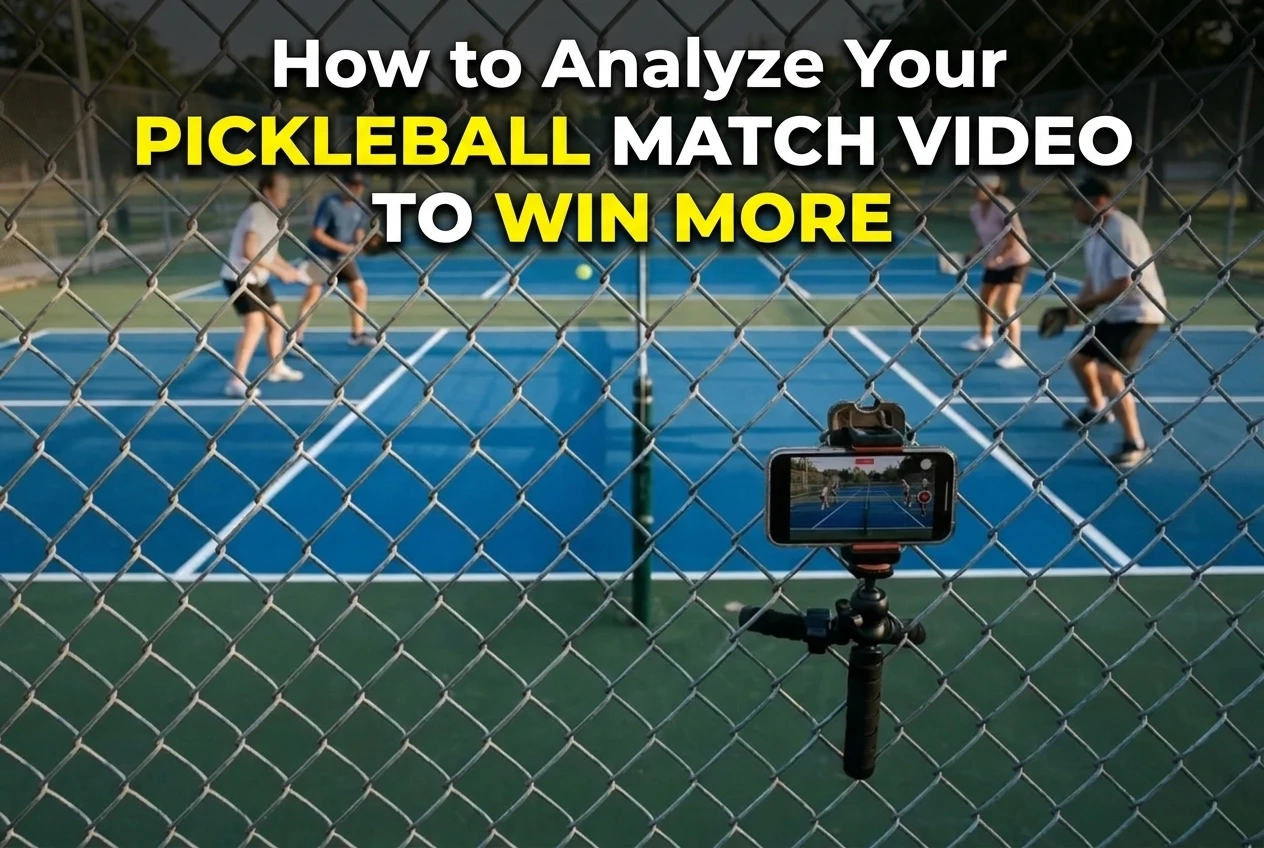
Film from behind your own baseline, centered on the court, and as high as you can manage. A tripod clipped to the fence, a bag hung on the net post of the next court, or a phone mount on a tall stand all work. Use landscape orientation and check that all four corners of your side and the kitchen line on the far side are in the frame.
A few practical points make the footage more useful:
- Film from your own end, not the opponent’s, so you see the court the way you play it: your partner beside you, the opponents’ paddles and feet ahead.
- Keep the camera still. A phone held by a friend who follows the ball loses the positioning you are trying to study.
- Check that the score is audible or visible. If you call it out clearly before each serve, you can log it later without guessing.
- Start recording before warm-up ends and stop after the last point, so the file is one continuous match.
Phone storage and battery run down during long tournament days, so clear space and plug in a battery pack before you start. A match recorded at the wrong angle teaches little, and a match missing its last ten points can hide the pressure situations you most want to see.
Watch with a question, not a feeling
Before you press play, decide what you are looking for. Without a question, you will fixate on the points that stung the most, and those are not always the points that cost you the match.
Write one question on your sheet. Good ones are specific enough that the video can answer them:
- Why did we lose the points that ended on our third shot?
- Where was I standing when the ball came back after my drop?
- What did I do on the points at 8-all or later?
If you have no particular suspicion, use a general one: “What ended the points I lost?” That question works with the tagging system in the next section.
Decide, too, how you will watch. Skip the points you won, at least on the first pass. Winning points hide errors, but your lost points are where the correctable patterns sit, and watching only those cuts the review to a manageable length. Set the playback speed to normal so you can judge timing and footwork, and use the scrub bar to jump from one point to the next.
Tag every lost point by cause: shot, position or decision
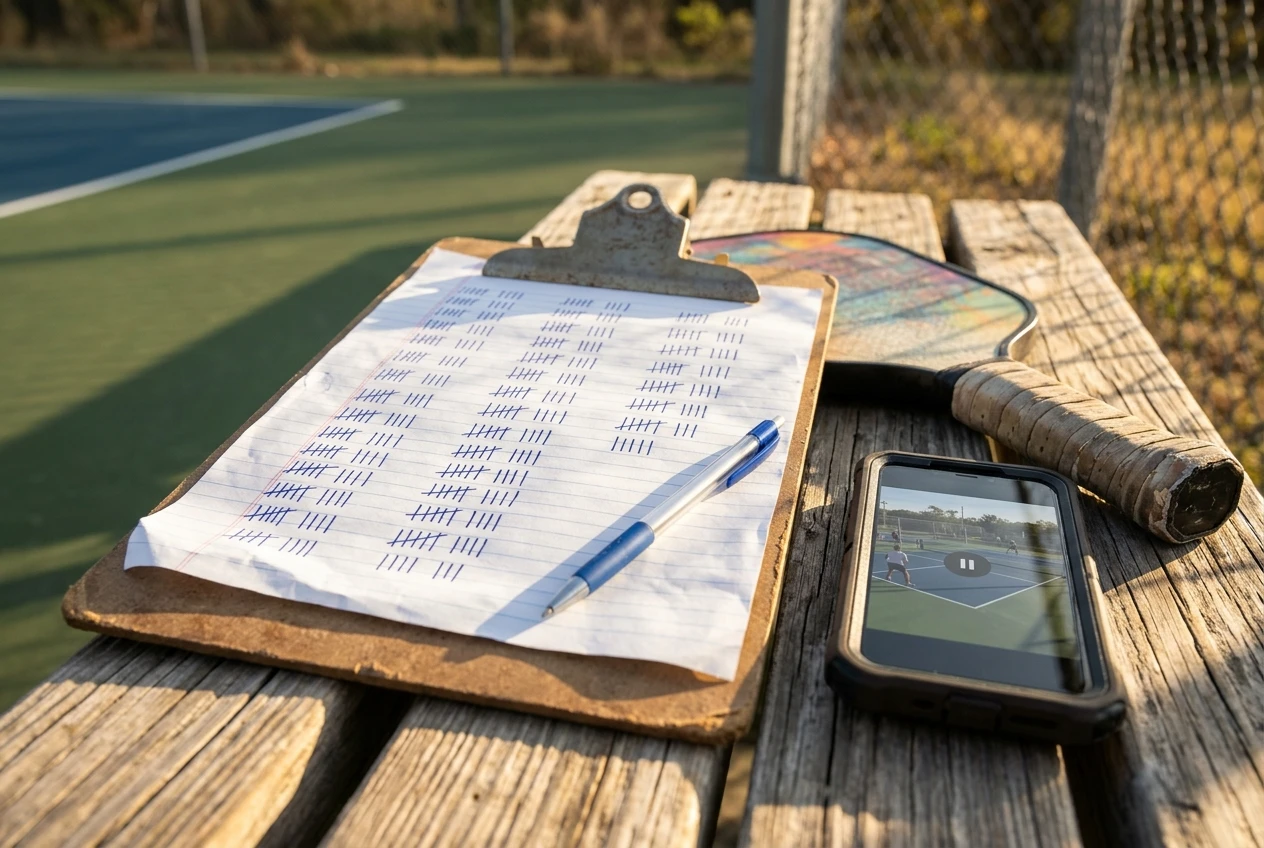
Open a sheet with a row for each point you or your side lost. Note the score, who served, and the cause. Every lost point gets exactly one cause tag.
Shot. You chose a sensible play and did not execute it. The ball went into the net, long, or wide, or it floated up when you meant to keep it low. The decision was right and the position was fine; the swing or touch failed.
Position. You were standing where you could not play the ball well. You stood behind the kitchen line when the dink was short. You and your partner left a gap in the middle. You drifted too far to one side after a drop and were caught flat-footed on the reply. The shot might have been playable from a better spot.
Decision. You were in position and capable of the shot, but you chose the wrong one. You hit a hard drive at an opponent who was ready at the kitchen line, tried a lob with no setup, or speeded up a ball that called for a neutral reset.
Some points seem to fit two tags. Use a rule to break ties: ask what you would change first. If a better choice would have avoided the error, tag it a decision. If a better choice was impossible because you were out of position, tag it position. If you made a good choice from a good spot and missed, tag it shot.
Add a second column for the situation. Keep the labels simple: serve, return, third shot, dink rally, volley exchange, overhead or lob, or reset from the transition zone. This is the column that makes the count useful, because “I lose points on position” is a vague conclusion, while “I lose points on position in dink rallies” is one you can train.
Do not tag a point by what the opponents did well. Credit goes to them in your mind if you like, but the sheet tracks what you could control.
Read the patterns: where you stand at the kitchen line, which balls you pop up, what you do under pressure
When the sheet is complete, count the tags. Tally shot, position and decision first. Then break the largest group down by situation and count again. Mark whichever combination has the most points, for instance “decision errors on the return” or “position errors in the dink rally.”
An illustrative case: suppose a match sheet shows eleven lost points, with six tagged position. Four of those six are in dink rallies, and in all four you are a step behind the kitchen line when the ball bounces short. That is one clear finding. Without the count, it would have been one of several half-noticed flaws.
Three areas are worth a second look even if they are not the biggest group:
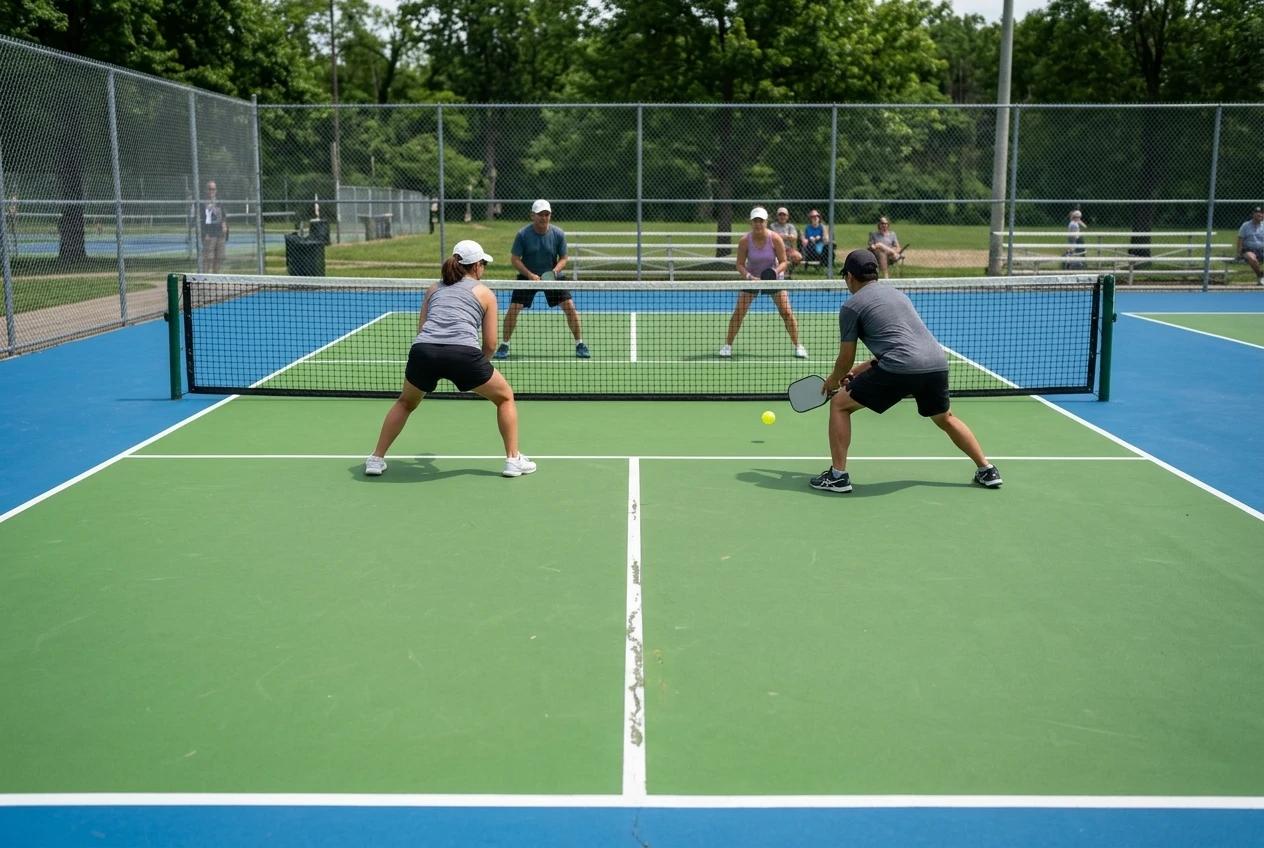
- Where you stand at the kitchen line. Pause at the moment the opponent contacts the ball. Are you close enough to the line that a short dink can be reached without lunging? Are you square to the ball, or turned toward your partner? Do you move forward and back together, or does one of you stay put?
- Which balls you pop up. Find every ball you put in the air above net height that an opponent then attacked. Note the shot that preceded it: a third shot drop, a dink under pressure, a reset from below the knee. If the pop-ups cluster on one shot, that shot is the candidate for a drill.
- What you do under pressure. Check the points late in each game, or those after a run of lost points. Compare your shot choices to the earlier points. Players often speed up the ball, go for lines, or stop moving their feet when the score is tight, and that shows up as a spike in decision tags.
Resist the urge to fix everything the sheet reveals. A second tier of problems exists in nearly every match, and chasing them dilutes your practice time. The count tells you which problem to deal with first.
Check your partner’s and opponents’ habits, not only your own
A match involves three other people, and each of them gives you information. Your own tags are the priority, but a second, quick pass over the footage can show things your sheet cannot.
For your partner, watch how you move as a pair. Do you shift together as the ball moves, or does a gap open between you? Who takes the middle ball, and is that agreed or accidental? If you stack or switch sides after serving, do you both arrive in position before the return lands? Some of your position tags may belong to a partnership habit rather than to a single player, and you can only fix that by discussing it with your partner, ideally with the video in front of both of you.
For the opponents, look for repeated patterns that you could use:
- Which side do they hit to when pressed, forehand or backhand?
- Do they reset from the transition zone or try to drive through it?
- Does one player stay back at the baseline while the other holds the kitchen line?
- Which ball do they attack: the high dink, the one down the middle, or the drop that lands deep?
Write two or three observations. Most club and tournament players meet the same opponents more than once, and the notes carry value beyond a single match. Use them as part of your plan at the start of the next one.
Turn one finding into one drill and one rule for the next match
Take the top combination from your count and write it as a sentence: “I lose points in X situation because of Y cause.” Then write two actions.
One drill. Choose practice that reproduces the situation and lets you repeat it many times. If the finding was a pop-up on the third shot, the third shot drop fix guide, linked below, covers the common causes. If it was a position error in dink rallies, a dinking drill with a partner where you track your feet is more useful than hitting random balls.

One rule. A rule is a single instruction you can hold in mind during play, because you cannot apply a drill’s lessons in the middle of a point. Make it concrete and observable:
- “After every dink, step back to the kitchen line before the ball crosses the net.”
- “On the return, hit deep and middle until the opponents hit a short ball.”
- “When the score is tied late in the game, choose the neutral shot first.”
Avoid rules that ask for a feeling, such as “stay calm” or “be aggressive.” A rule works when someone watching the video could check whether you followed it.
Keep the plan to one drill and one rule. Two or three changes at once are hard to measure, and you will not know which one made a difference.
Rewatch to confirm the change worked
The week after, run a short routine. Record your next match from the same angle, so the footage is comparable. Watch only for your target situation, not every point, and use the same tags.
A simple sequence works:
- Before the next match, reread your sentence and your one rule.
- Record the match from behind the baseline, same height and position as before.
- Find every point that involved your target situation: every third shot, or every dink rally, depending on your finding.
- Count how many of those points you lost to the original cause, and compare with the first match.
- Check how often you followed your rule, even on points you won.
If the count dropped, keep the drill going until the new habit holds under pressure, then return to the full sheet and find the next pattern. If it did not, check whether you followed the rule. If you did and the count held, the drill may not reproduce the situation well, or the finding was a symptom of something earlier in the point. Go back to the footage and look at the shot before the error.
One match is a small sample, since a single opponent can distort a count. When you can, combine the sheets from two or three matches before settling on your top pattern.
Pick one pattern and work on it this week
Your next match video will show you something specific if you count what you see. Once the tally points to a pattern, two guides on this site can help you fix it. If your pop-ups come off the third shot, read why your third shot drop keeps popping up and how to fix it. If your errors come in kitchen-line rallies, the pickleball dinking drills give you practice that targets them.
Record your next match, tag your lost points, and choose one pattern from the count. Drill it for a week, apply one rule in your next match, and then watch the footage again to see whether the number has moved.