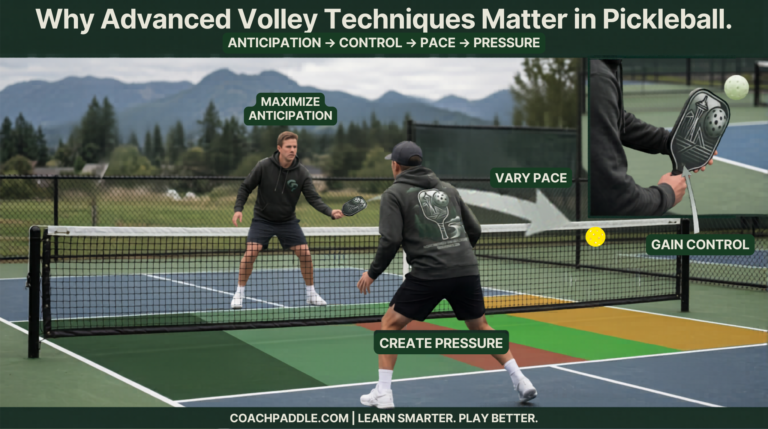
Most tournament players who struggle with pickleball doubles positioning at the kitchen line have no shot problem. They see the angle late. By the time the ball leaves the opponent’s paddle, the only options left are a lunge, a stab, or a step that crosses into the partner’s space. Reading the cues before contact and moving with your partner as one unit fixes this without any change to your strokes.
This guide covers where to stand, what to watch on the opponent’s side, the three angles that cause the most trouble, and how to shift together so the middle stays closed. Stroke mechanics are covered elsewhere on this site, with links where they matter.
Why you get pulled off the kitchen line in the first place
Being pulled off the line usually comes from one of four habits:
- Watching the ball instead of the opponent. The ball tells you where it is. The opponent’s paddle and body tell you where it is going.
- Standing on the line with weight forward. From there, a ball hit at your feet or over your head leaves you no room to adjust, and you lose balance reaching for it.
- Reaching instead of stepping. An angled dink pulls your paddle arm out while your feet stay put, so your body is no longer square to the net and your next ball is a guess.
- Both players chasing the same ball. One partner crosses over to rescue a wide dink, the other stays where they were, and the gap between you becomes the target.
Every item on that list is a timing problem. If you know the direction half a second sooner, you can step instead of reach, and your partner can adjust instead of being surprised.
Where to stand: the baseline position that gives you the most reach on both sides
Your ready position is the spot you return to after every shot. Everything else in this article assumes you have it.
Stand a few inches behind the kitchen line, not on it. From there, one step forward reaches a short dink, and one step back handles a ball driven at your feet or lifted over your head. On the line, you only have the first option.
Center yourself in your half of your side of the court. Being too wide gives away the middle, and being too close to the center line gives away the sideline. Start in the middle of your zone and let the ball’s location move you from there.
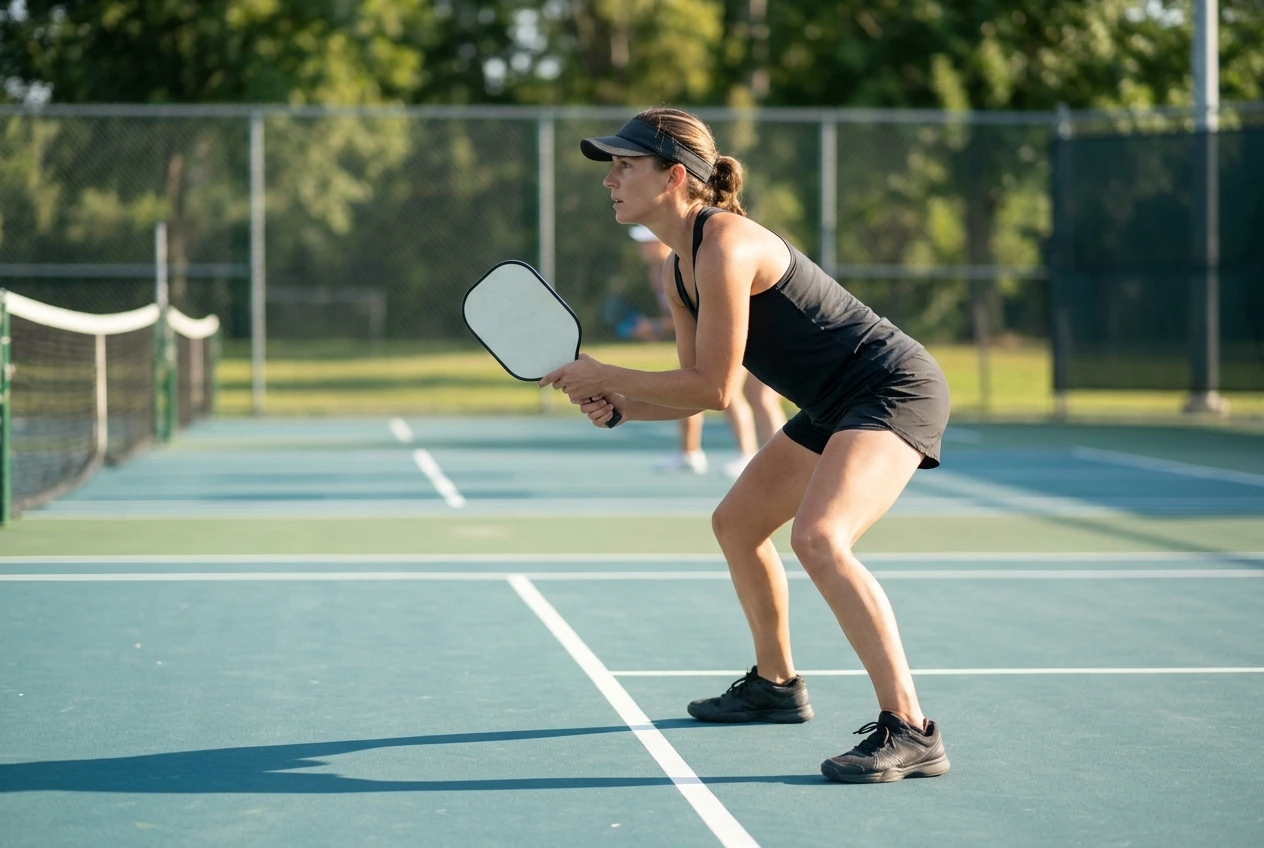
Your body should be set up the same way every time:
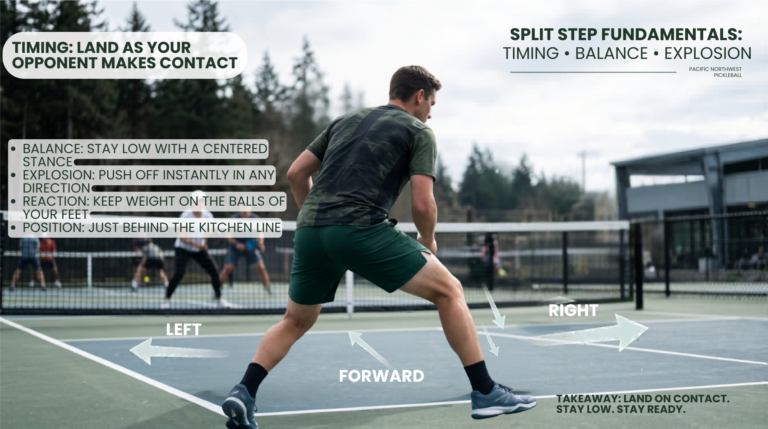
- Knees bent, weight on the balls of your feet.
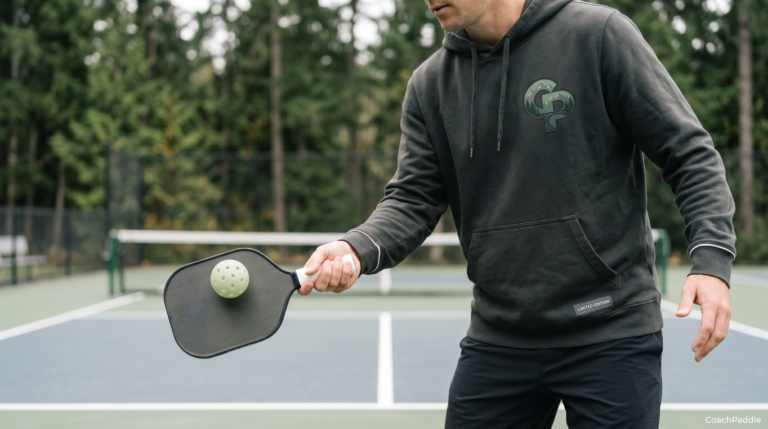
- Paddle up in front of your chest, face slightly open, so it is already close to where most contacts happen.
- A small split-step as the opponent makes contact, so your feet are moving when you need to push off.
The split-step matters most. A player who lands from a split-step just as the opponent hits can go in either direction. A player standing flat has to shift weight before moving at all, and that costs the half second you are trying to save.
Reading the opponent’s paddle face and body shape before the ball arrives
Three signals show up before the ball crosses the net: paddle face, body shape, and ball height. Each gives only a partial answer, but together they usually narrow the next shot to one or two options.
Paddle face
The ball leaves roughly in the direction the paddle face points at contact. A face tilted open and upward means the ball is being lifted: a dink, a reset, or a lob. A flat or closed face means the ball is being driven. A face angled across the body, with the paddle traveling from one side to the other, points toward a cross-court shot.
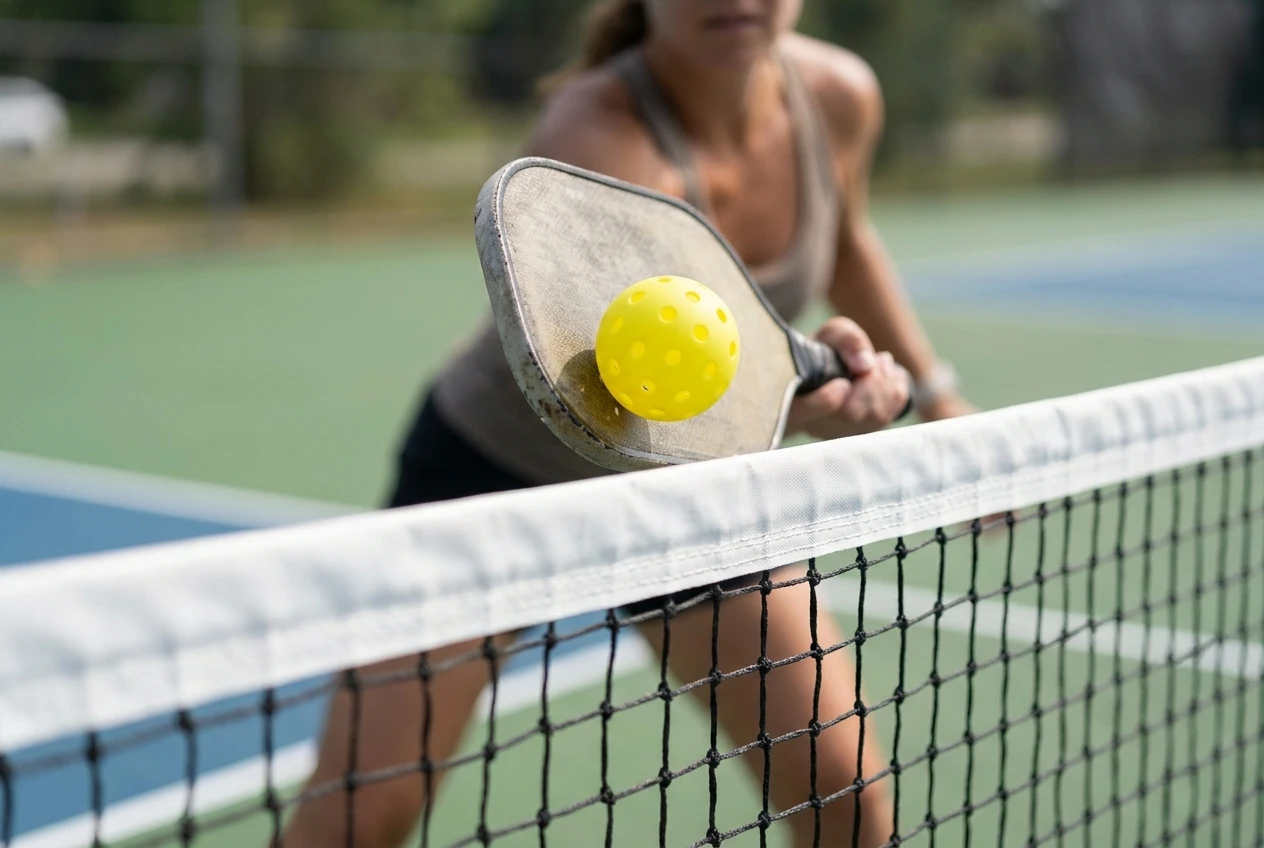
You can see this a split second before contact. Practice picking up the face angle as the opponent’s paddle comes forward, not at the moment of impact.
Body shape
Shoulders and hips show direction. If the opponent’s chest turns toward a sideline as they swing, the ball is likely heading that way. If their hips stay square to the net, a straight or middle shot is more likely.
Balance tells you a lot too. A player stretched wide or stumbling forward rarely has the control for a sharp angle and usually just gets the ball back, often straight. A player set in a stable stance with time to spare can place the ball wherever they like, so you have to stay ready for any direction.
Ball height
Compare the ball’s height to the top of the net when it reaches the opponent’s contact point. If it is below the net, they have to lift it, which limits them to a soft dink or a lob. If it is above the net, they can hit down, and the speed-up becomes likely, often at your body or into the middle.
Ball height is the easiest of the three signals to read, because you are watching the ball anyway. Use it to decide how ready you need to be for a fast ball.
The three angles that beat most tournament players (and the early cue for each)
1. The wide cross-court dink
This is a soft ball that lands near the sideline of the kitchen and bounces away from you. It beats players who stand too close to the center and who reach with the paddle rather than moving the feet.
Early cue: the opponent’s face is open and slicing across the ball, their body opens toward the sideline, and the ball is low relative to the net. Response: take your first step toward the sideline as they swing, and let your partner slide toward the center to cover the space you leave.
2. The ball down the middle
A flat or driven ball between you and your partner causes more confusion than almost any other, because each player hesitates and assumes the other will take it. It most often follows a ball that sits above the net.
Early cue: hips square to the net, a flat or closed face, and a ball that arrives higher than the net. Response: agree before the match on who takes the middle (many teams give it to the forehand player) and call it out loud when it happens. For the stroke itself, the volley article covers the contact and the compact swing.
3. The down-the-line change
Two opponents trade cross-court dinks for several balls, and then one turns the paddle straight ahead and sends the ball down the sideline. By then you are leaning cross-court, so you move the wrong way.
Early cue: a late shoulder turn, or contact that comes slightly earlier and farther in front of the body than in the previous dinks. A paddle that points down the line instead of across is the clearest signal. Response: after the second or third cross-court ball in a row, stay a little more balanced, and let your eyes check the paddle each time instead of assuming the pattern will continue.
Moving with your partner: shifting as a unit so the middle never opens
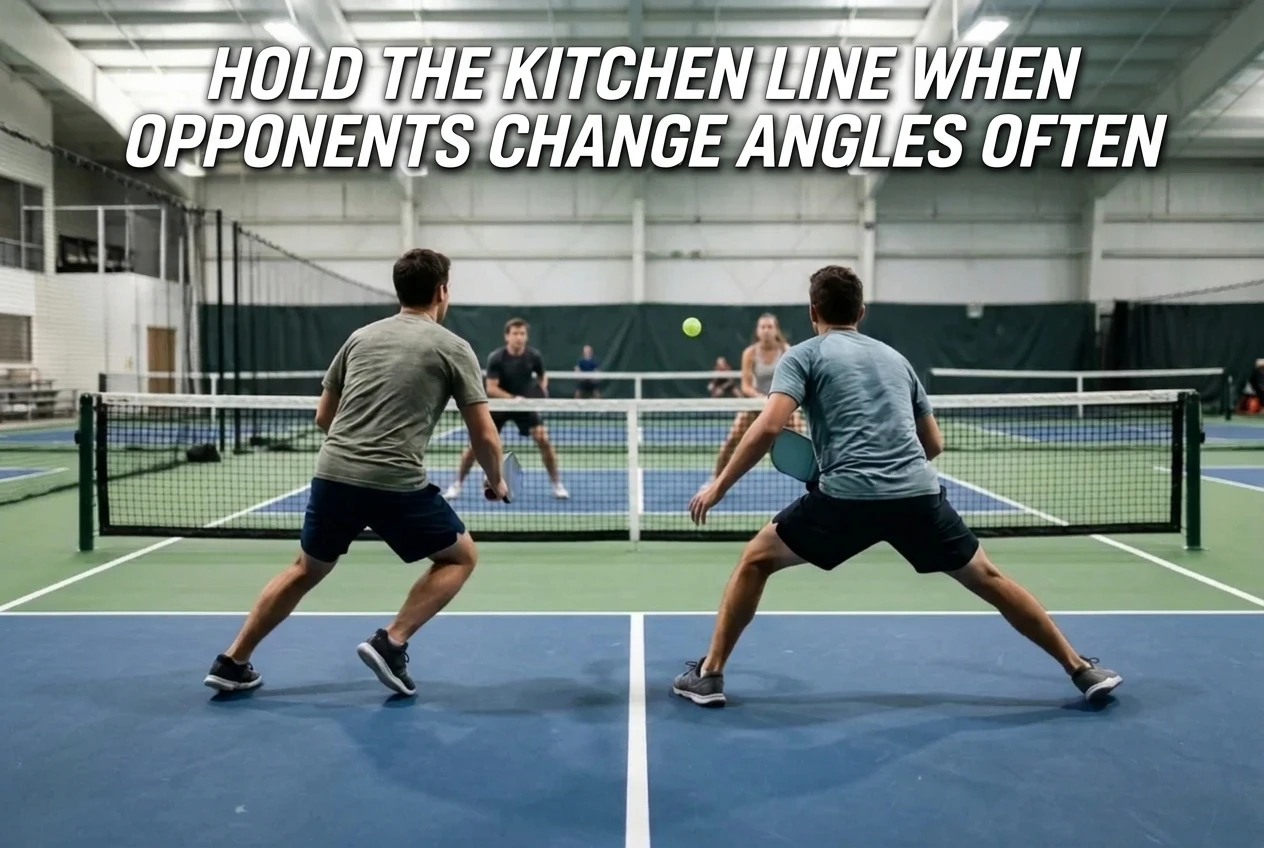
Two players covering one side of the court each need to know where the other is without looking. The simplest way to do this is to move in the same direction at the same time, as one unit.
When the ball goes to your side, you shift toward it and your partner shifts the same direction, though a shorter distance. When your partner is pulled wide, you slide toward the center. The gap between you stays about the same, close enough that either of you can reach a ball between you with one step.
Four habits keep the unit together:
- Move on the opponent’s contact, not on the ball’s bounce. The split-step and the first step happen as they hit.
- Stay level. Neither partner should be much closer to the net or farther back than the other. A player who is deeper leaves the one at the line exposed to balls at the feet.
- Call it. Short words like “mine,” “yours,” and “switch” prevent hesitation. Agree on them before you play so nobody has to think.
- Shift back after the point is dead. Return to the center of your zone after each ball rather than staying wherever the last shot left you.
When your partner is clearly out of position and the ball is going to land where they are not, a quick switch can be better than a rescue. Make that decision early, with a call, not at the last moment.
What to do when you are forced back, and how to earn the line again
Everyone is pushed back sometimes. A deep drive, a lob, or a fast ball at the feet will move you off the line. What matters is the first ball you hit after that and how you move afterward.
Hit a neutral ball first. A soft drop or reset that lands in the kitchen takes the pressure off and buys time for both of you to move forward. If your drops tend to pop up, this article on fixing the third shot drop covers the mechanics.
Then move up with your partner, not alone:
- Hit the reset and watch where the opponent’s ball is going to land.
- Take two or three steps forward together while the opponent prepares their shot.
- Split-step as they make contact, even if you are not yet at the line.
- Continue forward on the next ball that bounces low. A ball that stays below the net gives you the chance to step in.
If one partner is at the line and the other is still back, the player at the line is the target for a fast ball at the feet. Match each other’s depth even when it means staying slightly farther back for one more ball.
Two drills to build anticipation, plus a quick checklist for your next match
Drill 1: Call the angle
Stand at the kitchen line with a partner and a feeder across the net, who dinks to either side or hits a faster ball. Before the ball crosses the net, call out “wide,” “middle,” or “line” as you read the opponent’s paddle and body. Count how many calls you get right in a set of 20.
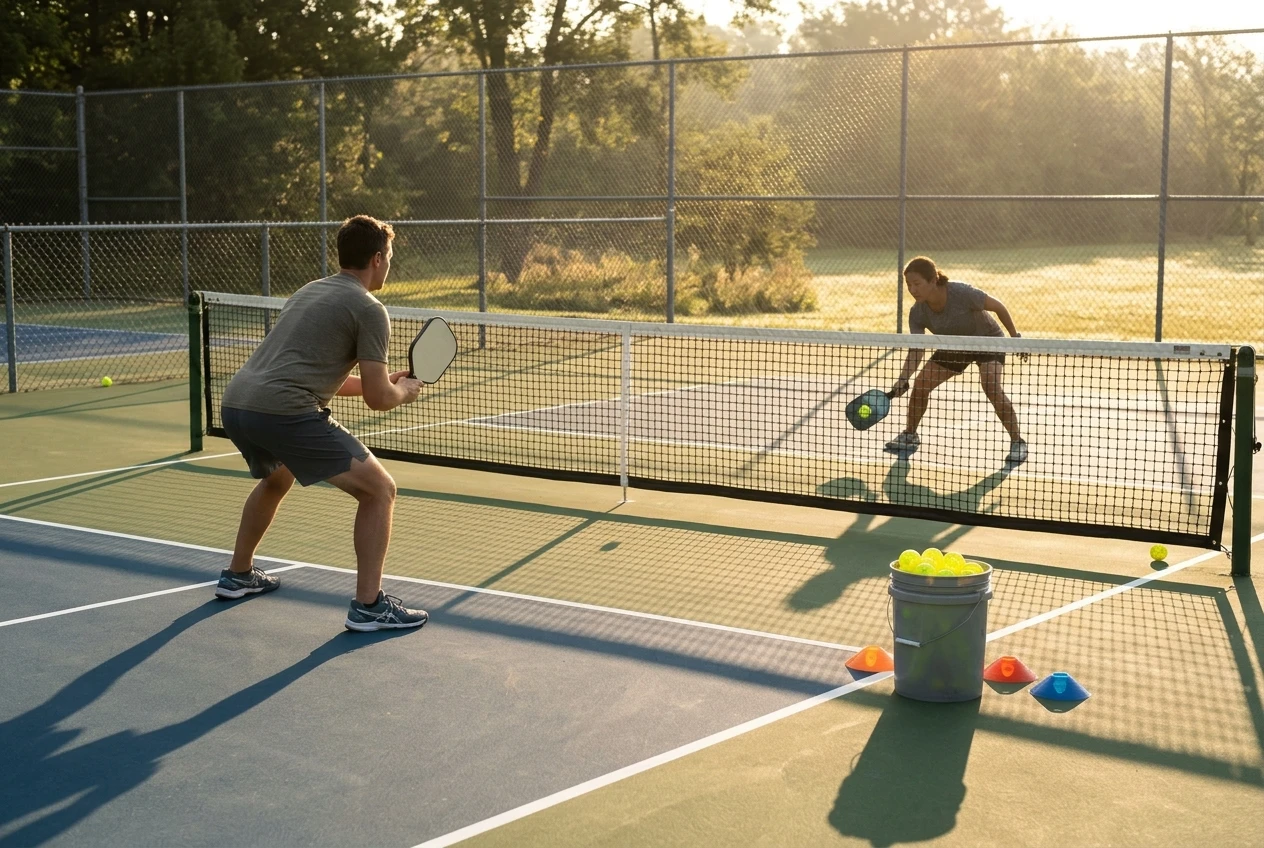
The goal is to improve your calls, not your hits. Your accuracy should rise over a few sessions as you learn what each cue looks like. For ideas on the dinking itself, the dinking drills page has practice formats you can adapt.
Drill 2: Shift as a unit
Two players stand side by side at the line while one or two opponents dink at random across the net. The team has to keep a fixed gap and shift together on every ball. Any ball that lands in the gap between them counts against the team.
Add a rule once it feels easy: the feeder can speed up the ball once per round, so you practice the shift on a fast ball as well as a soft one.
Quick checklist for your next match
- Start each point a few inches behind the line, centered in your zone, with a split-step on the opponent’s contact.
- Check the paddle face before the ball crosses the net.
- Compare ball height to the net to judge whether a speed-up is likely.
- Watch for the late shoulder turn that signals a down-the-line change.
- Agree with your partner on who takes the middle, and call every ball in that area.
- Shift together, stay at the same depth, and return to your zone after each shot.
- If you are pushed back, reset first, then move forward as a pair.
Pick one or two items for each match. Once those become automatic, add another.