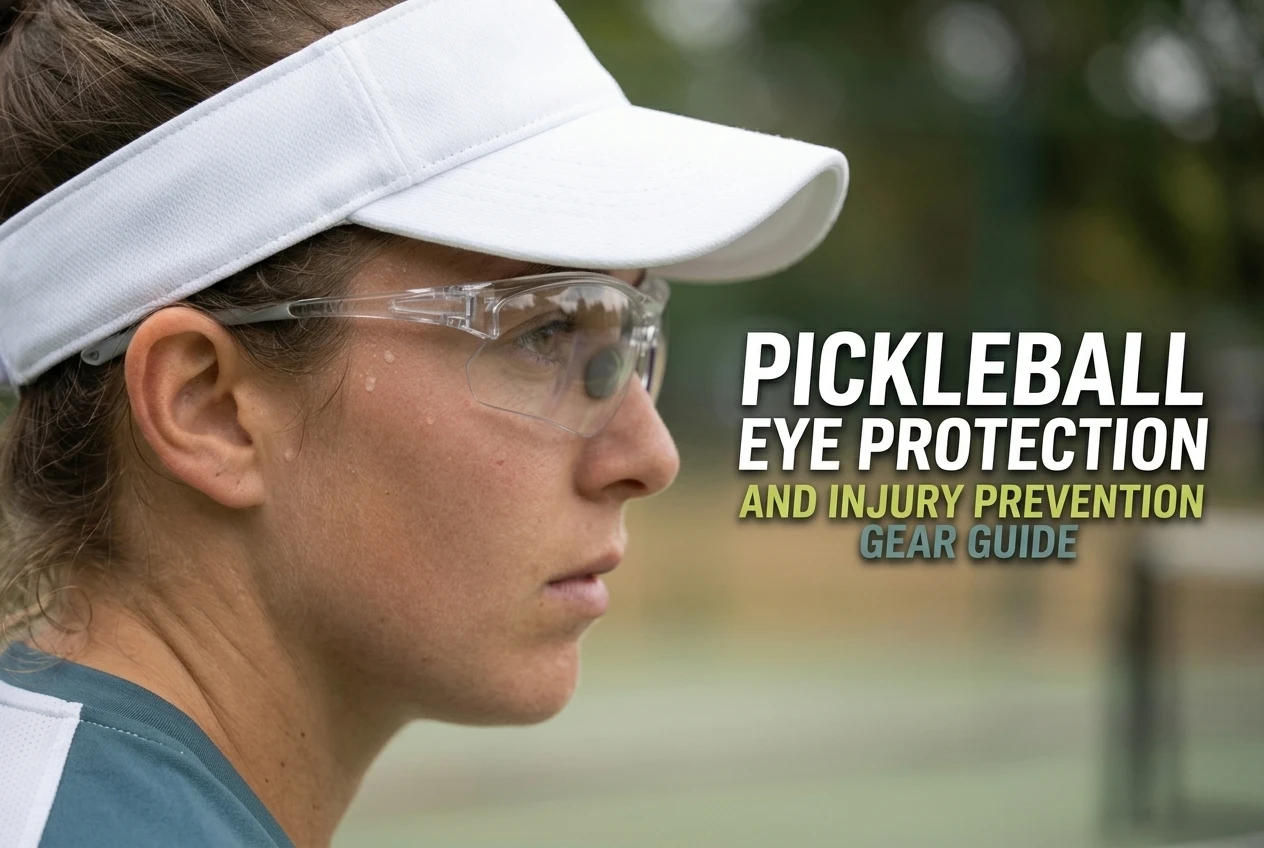
Pickleball protective eyewear and injury prevention gear gets lumped into one shopping list most of the time: goggles, a knee brace, a wrist wrap, a tub of electrolytes. For a competitive player, that list is too broad to be useful. The injuries that take tournament players off court are eye strikes, knee problems and wrist or elbow overuse, and each one calls for a different decision.
This guide takes them in that order, with the criteria to check before you buy. Ankles and footwear are covered in the shoe guide linked at the end.
Why Pickleball Eye Injuries Happen and Why Regular Sunglasses Are Not Protection
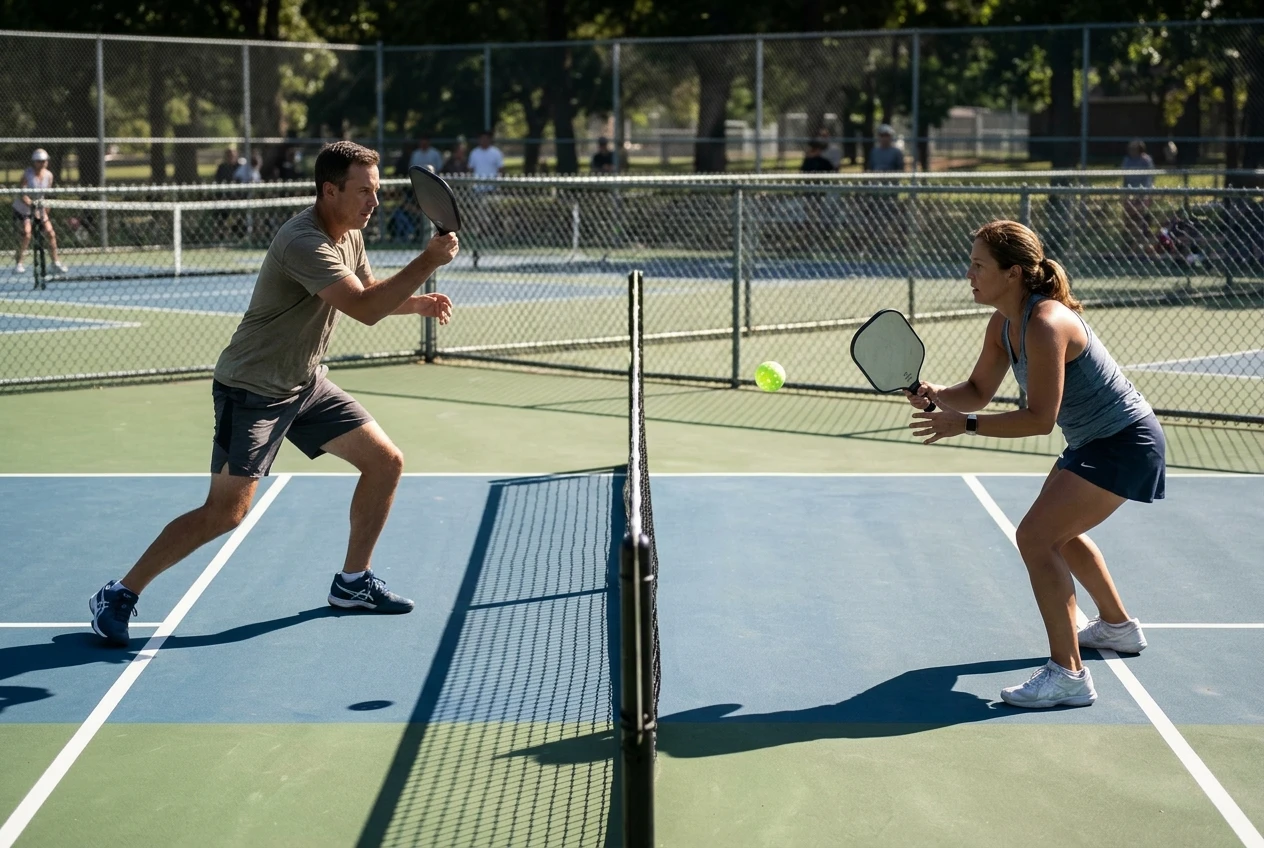
The pickleball is a hard plastic ball, and the game is played at close range. At the kitchen line, two players can trade fast volleys from a few feet apart, with very little time between the paddle contact and the ball arriving. In doubles, you also share the court with a partner and two opponents, so a miss-hit, a deflection off a paddle edge or a ball from the next court can come from an angle you weren’t watching.
Eyes are the one part of the body where a single impact can cause damage that doesn’t heal. That is why eyewear belongs at the front of any list of injury prevention gear, ahead of braces.
Regular sunglasses and prescription glasses are made to cut glare or correct vision. Most are not designed or tested for the impact of a ball, and a lens that cracks or a frame that flexes inward can add to the injury. Eyewear made for racquet sports is built and tested for impact, which is a different category of product even when the two look alike on a shelf.
A common objection from stronger players is that they see the ball well and rarely get hit. That is a statement about how often it happens. The risk at the net is about how bad the one bad outcome is, and the cost of wearing eyewear is small by comparison.
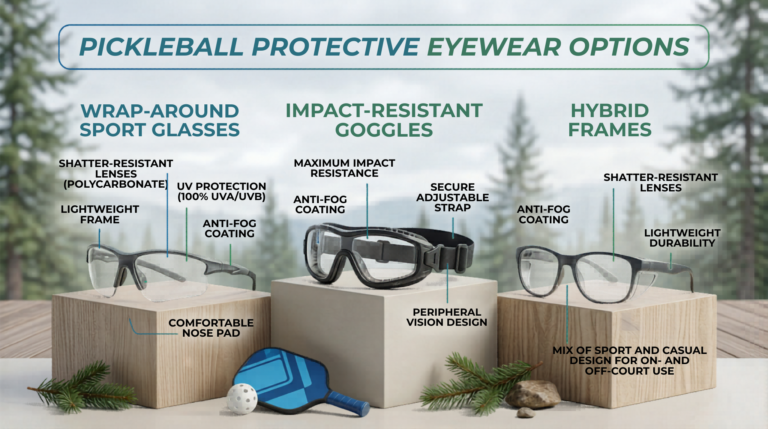
What to Look for in Protective Pickleball Eyewear: Impact Rating, Lens, Fit, Fog
Four criteria separate useful eyewear from the kind that ends up in the gear bag unused.
Impact rating
Look for eyewear that states an ASTM impact rating for racquet sports. The rating should appear on the product page, the packaging or the manufacturer’s specification sheet. If you can’t find a stated standard, treat that as a reason to keep looking. Marketing words like “sport,” “shatterproof” or “tough” don’t tell you what the product was tested against.
Lens material and tint
Polycarbonate is a common lens material for impact-rated eyewear. Beyond the material, think about where you play. Outdoor courts in bright sun call for a tint or a photochromic lens, while indoor courts with bright overhead lighting often do better with a clear or lightly tinted lens. Playing both means you may need two lenses, or a frame that accepts swappable ones.
Check that the lens doesn’t distort at the edges. You are tracking a small ball against a busy background, and a lens that warps your peripheral view will cost you more points than it saves.
Fit under a hat or visor
Many competitive players wear a visor or cap, so test the eyewear with yours. Frames that sit high can press against the brim, and thick temples can push a cap out of position. Check three things before you commit:
- The frame stays put when you shake your head and when you look down to a low ball.
- The nose bridge doesn’t slide when you sweat.
- Nothing rubs behind your ears after an hour of play.
If you wear prescription lenses, look at whether the frame is designed to take a prescription insert or whether you would need a separate prescription sport pair. An optician can explain the options for your prescription.
Fog control
Fog ruins the one thing the eyewear is for. Airflow around the lens is the first defense, so frames with vents or a small gap at the top and sides tend to help. Anti-fog coatings help too, though they wear down with cleaning. Wiping the inside of a lens with your shirt tends to scratch the coating, so carry a microfiber cloth in your bag.
Try the eyewear in warm conditions before a tournament day, not on the morning of one. A pair that stays clear in a cool gym can behave differently in a humid outdoor bracket.
Knee Braces and Sleeves: When Compression Is Enough and When You Need Support
Pickleball puts knees through repeated bending, quick stops and sideways pushes, often on hard surfaces. The question to ask about knee gear is what you want it to do, because compression and support are different jobs.
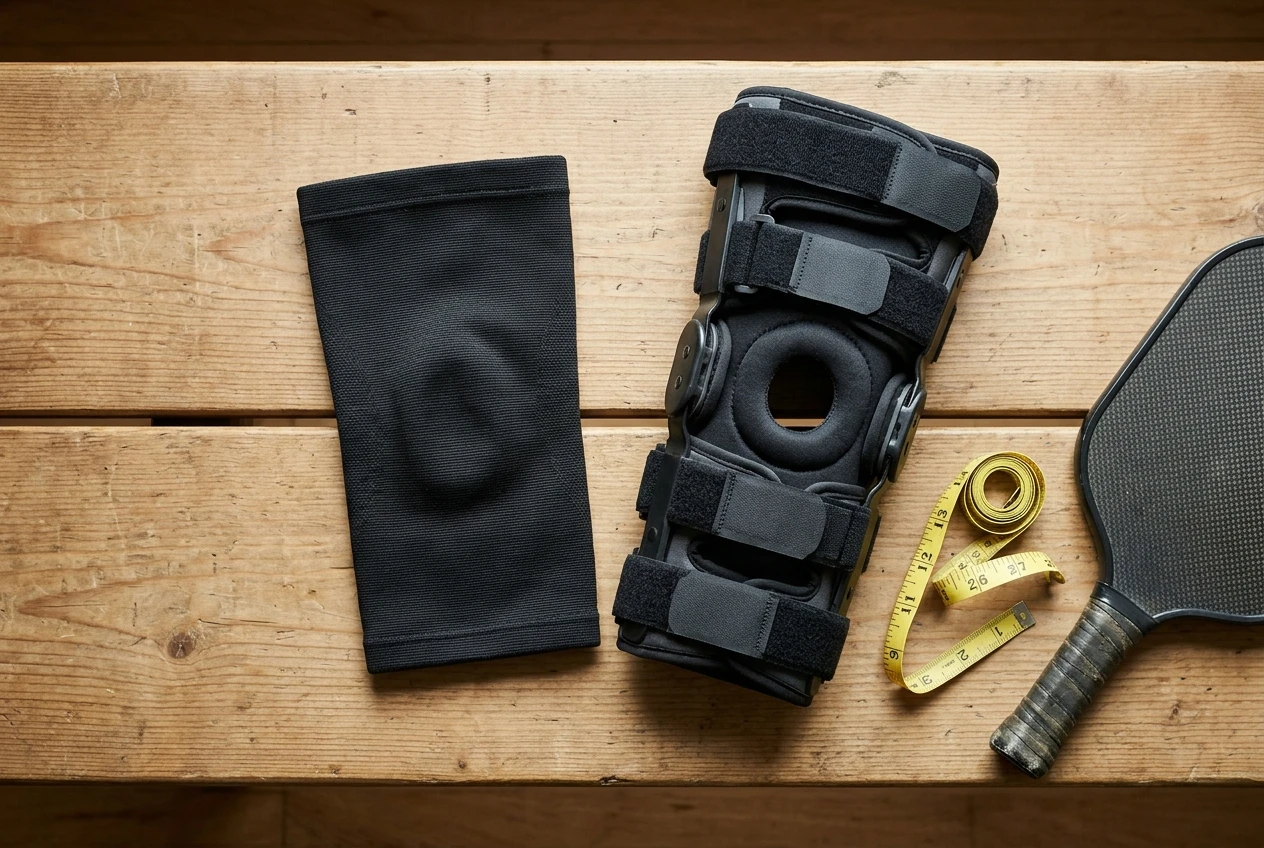
A compression sleeve applies even pressure around the joint. Players often use one for warmth and for a better sense of where the knee is in space. It does not mechanically stop the knee from moving in a harmful direction. A sleeve fits a player whose knees feel stiff or achy but stable, and who wants a little extra feedback during long days.
A supportive brace adds structure, such as side hinges, straps or a patellar buttress. Braces are meant to limit certain motions or guide the kneecap. They suit players who have had a specific problem, such as a sense of the knee giving way, and who have been told by a clinician that a brace is appropriate.
Some practical points:
- Knee pain that is new, sharp, swollen or that makes the knee feel unstable is a reason to see a physician or physical therapist before you buy anything. A brace can hide a problem you should have examined.
- Fit matters more than features. A sleeve that rolls down or bunches behind the knee gets pulled off between matches, and a brace that slides is no better than none.
- Sizing charts differ by brand, and measuring the leg at the stated point is more reliable than guessing a size.
- Wear it in practice first. A brace that changes how you move can alter your split step and your lateral push-off, and you should find that out before a bracket, not during one.
If you are unsure which category you fall into, a sleeve is the lower-commitment starting point, and a professional can tell you whether you need more.
Wrist and Elbow Protection for Players Who Hit a Lot of Volleys and Spin Shots
Wrists and elbows take the load from repeated volleys, quick resets at the kitchen and spin shots that rely on forearm and wrist action. Overuse is the usual cause of trouble here, and gear helps by reducing strain, not by removing the repetition.
Elbow
A counterforce strap is a band worn on the forearm just below the elbow. Players with outer-elbow soreness often use one to spread the load on the tendon where the forearm muscles attach. A sleeve gives warmth and mild compression instead. Neither replaces rest if the pain is building from match to match.
Wrist
Wrist wraps and light supports limit the extremes of bending, which can be useful if a spin-heavy game leaves your wrist feeling tired. A support that is too rigid can restrict the wrist action you need for touch shots, so choose the lightest support that gives you relief. If you feel numbness, tingling or pain that continues after play, get it checked.
Equipment that affects load
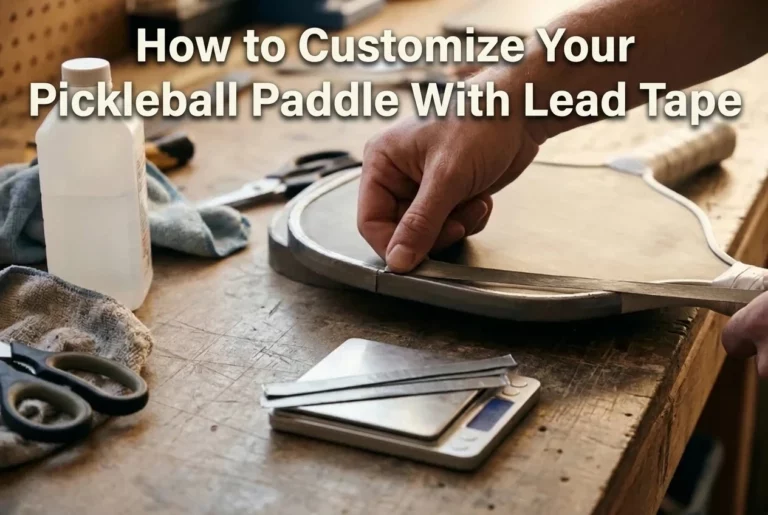
The paddle itself is part of the equation. Grip size, paddle weight and balance all change how much work the forearm does. If you are considering changing weight with pickleball paddle lead tape, add it in small amounts and give your arm time to adjust, since a heavier head can raise the strain on the elbow. A grip that is too small makes you squeeze harder, and an overgrip that has gone slick does the same.
Heat, Sun and Recovery Gear That Quietly Prevents Injuries Over a Long Tournament Day
Tournament days can run many hours, with gaps of unpredictable length between matches. Fatigue and heat reduce your coordination and reaction time, and those are the conditions in which mis-steps and late reactions happen. The gear for this problem is unglamorous but works.
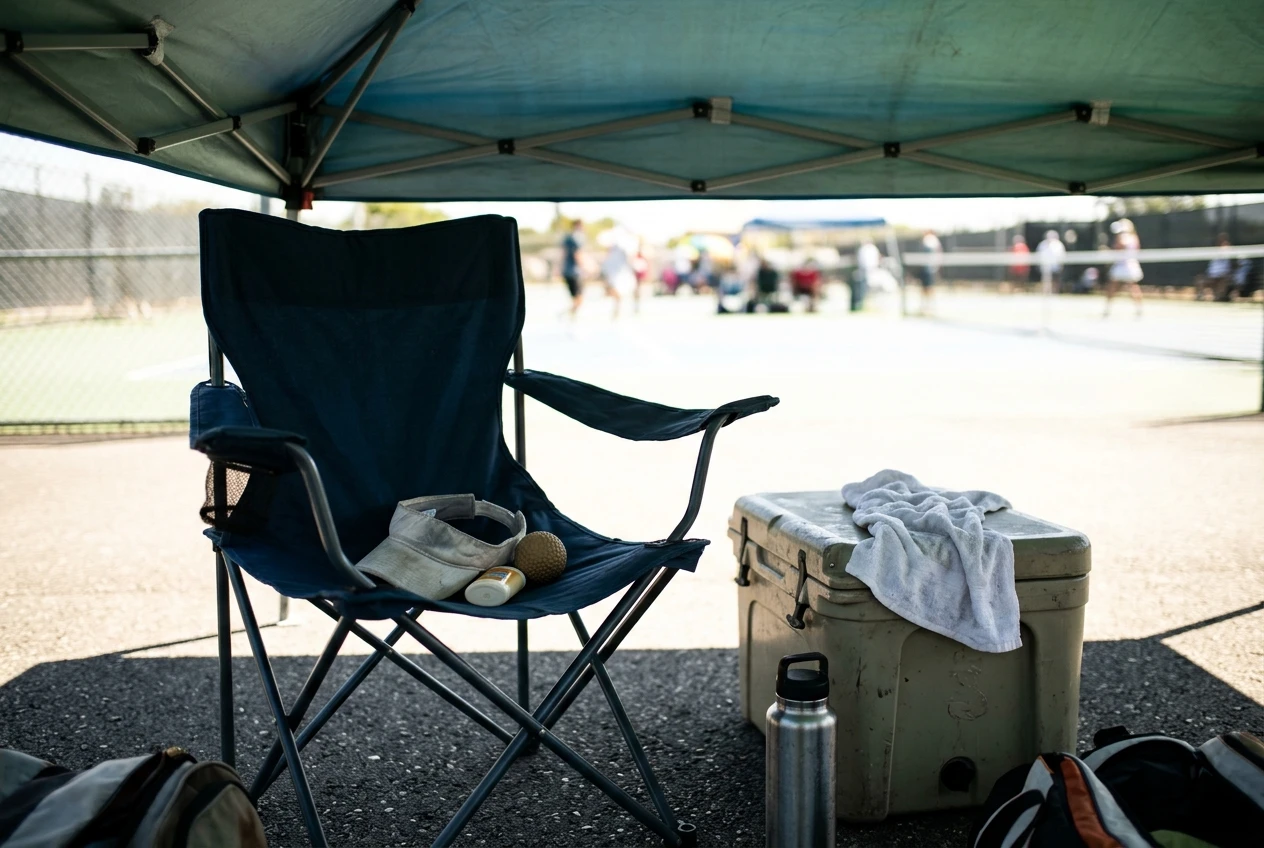
- Hat or visor and sunscreen: Sun exposure drains you over a day. Reapply sunscreen between matches, and keep it out of your eyes by using a stick or a non-sweat-run formula.
- Water and electrolytes: Carry more than you think you need and drink on a schedule instead of waiting for thirst. Whether you need electrolytes depends on heat and how much you sweat, so use what you already tolerate well.
- Dry layers and spare socks: Changing into dry clothes between matches helps you stay warm in cool venues and comfortable in humid ones.
- Shade and a cooling towel: A small pop-up shade or a towel kept in a cooler lowers your body temperature during breaks.
- Food you have tried before: Eat something simple and familiar between matches. A new product on tournament day is an unneeded variable.
- Light recovery tools: A massage ball or compact roller used between matches can loosen calves and forearms. Keep it gentle.
Our guide to what goes in a tournament pickleball bag covers how to pack these items so you aren’t carrying everything you own.
How to Build a Protective Kit in the Right Order If You Can’t Buy Everything at Once
Not everyone can buy the full list on one trip. A sensible order is based on how serious and how permanent the injury would be, and how likely it is for you.
- Impact-rated eyewear. An eye injury is the least reversible, and the cost of a pair is usually modest next to a paddle.
- Sun, hydration and a dry change of clothes. These cost little and affect every match you play.
- Gear for your own history. If you have had knee, wrist or elbow trouble, buy for that area next, after confirming what you need with a professional if the problem is recurring.
- Everything else. Preventive sleeves and straps for joints that have never bothered you can wait until the other items are covered.
Buy one item at a time and use it in practice for a week or two before a tournament. Gear that you haven’t broken in tends to get left in the bag, and a protective item you don’t wear protects nothing.
What Gear Can’t Fix: Warm-Up Habits and Movement Patterns That Protect Your Body
Gear reduces risk but does not make up for the habits that created it. A few habits make a larger difference than most products.
Warm up before you play. Start with easy movement such as light jogging, leg swings and arm circles, then hit some soft volleys and dinks before you go to full speed. Cold muscles and tendons are more likely to be strained by a sudden sprint to a lob.
Keep the paddle up. Holding the paddle in front of your body in a ready position protects your face and shortens your reaction time at the net. Players who drop the paddle to their hip are more exposed to a hard ball and slower to respond to it.
Use a split step. A small hop as your opponent makes contact lets you push off in either direction and takes pressure off the knees compared with stepping from a flat-footed stance.
Turn and move on lobs. When a ball goes over your head, turn your shoulders and move your feet, then set up for the shot instead of backpedaling and hitting off balance. Our overhead shot drills work on that movement.
Rest when pain is building. Soreness that increases from one session to the next is a signal to reduce volume, and no brace changes that. A day off is cheaper than a month out.
Where to Go Next
Ankles take a lot of the lateral loading in this sport, and the right footwear is half of any prevention plan. Our guide to choosing pickleball shoes that protect your ankles covers that side in detail.
Which injury do you most want to avoid: eyes, knees, or wrists and elbows? Share it in the comments, and the next coaching post will address the one players ask about most.