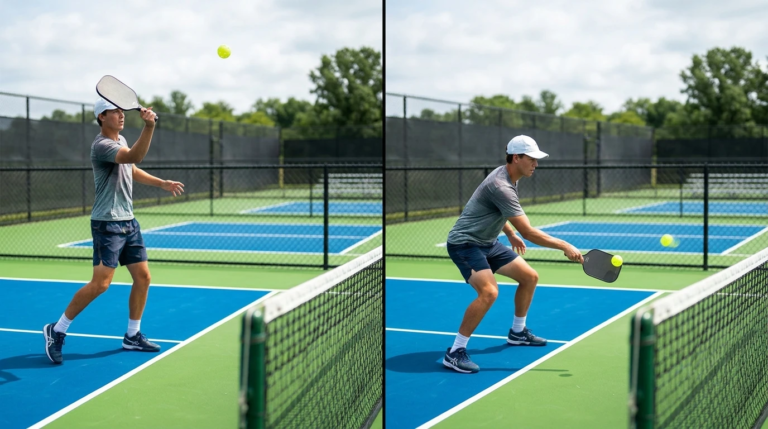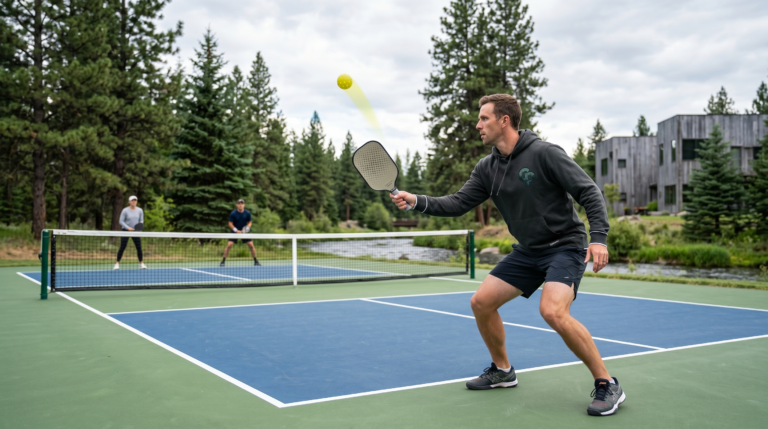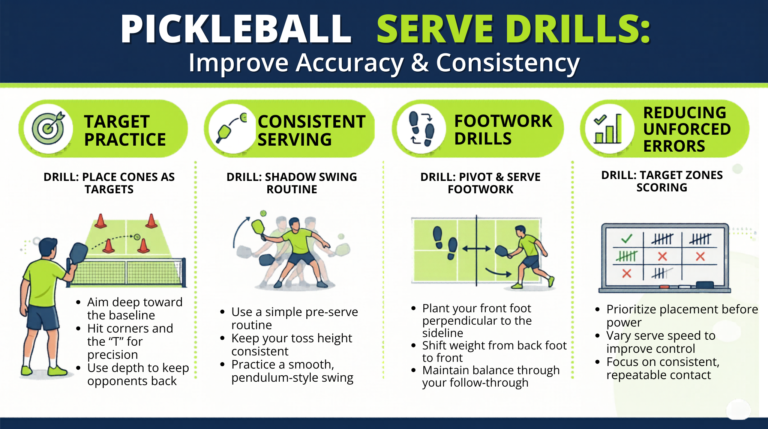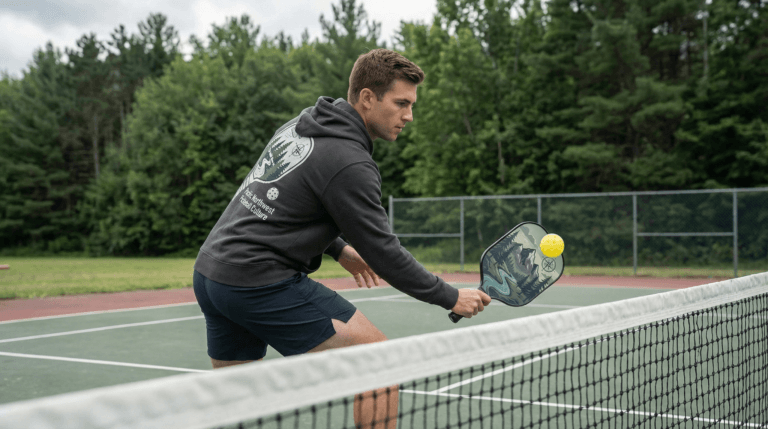
A speed-up happens when an opponent at the kitchen line hits a fast ball at you, usually at your chest, hip or backhand side, and expects you to either pop it up or hit back harder. Knowing how to reset a speed-up in pickleball means learning to absorb that pace and return the ball softly into the opponent’s kitchen. The usual advice is “soften your hands,” and it is correct, but it leaves out most of what your body has to do.
This article breaks the reset into its physical parts, shows the three most common ways it goes wrong, and gives you three routines you can do alone with a wall, a bucket of balls and a target.
What a reset actually is, and why it beats hitting back harder
A reset is a block that takes the speed off an incoming ball and sends it low over the net so it lands in the opponent’s kitchen. The goal is to make the next shot difficult for them. A ball that lands in the kitchen forces your opponent to hit up from near the ground, which takes away their chance to attack again.
Hitting back harder asks you to win a pace contest from a cramped position. The opponent is already set and closer to the net than you probably are, and a fast ball returned at speed often comes right back at you faster. A reset changes the situation instead of joining the race. You move from defending to a neutral exchange, and from there the point is open again.
The reset also needs less swing than almost any other shot, which makes it a good one to practice alone. The ball arrives with plenty of energy, so your job is to use the paddle to take energy away.
The five mechanics of a clean reset
Each of these five parts affects the others, so check all of them when a reset goes wrong.
Grip pressure
Hold the paddle loosely, firmly enough that it will not twist in your hand but loosely enough that the paddle can give slightly when the ball arrives. A tight grip sends the ball’s energy straight back through the paddle, and the ball leaves faster than it came in. Many coaches describe a loose grip as roughly a 3 on a scale of 10. Use that as a rough guide, and adjust it by watching what the ball does.
Paddle face
Keep the face fairly vertical, tilted only slightly open, and hold it still through contact. The more you tilt it up, the more the ball sails. A steady, almost upright face lets the ball drop off the paddle with little rebound. Hold the paddle out in front of you with the tip a little above your wrist so the face is ready before the ball is.
Legs
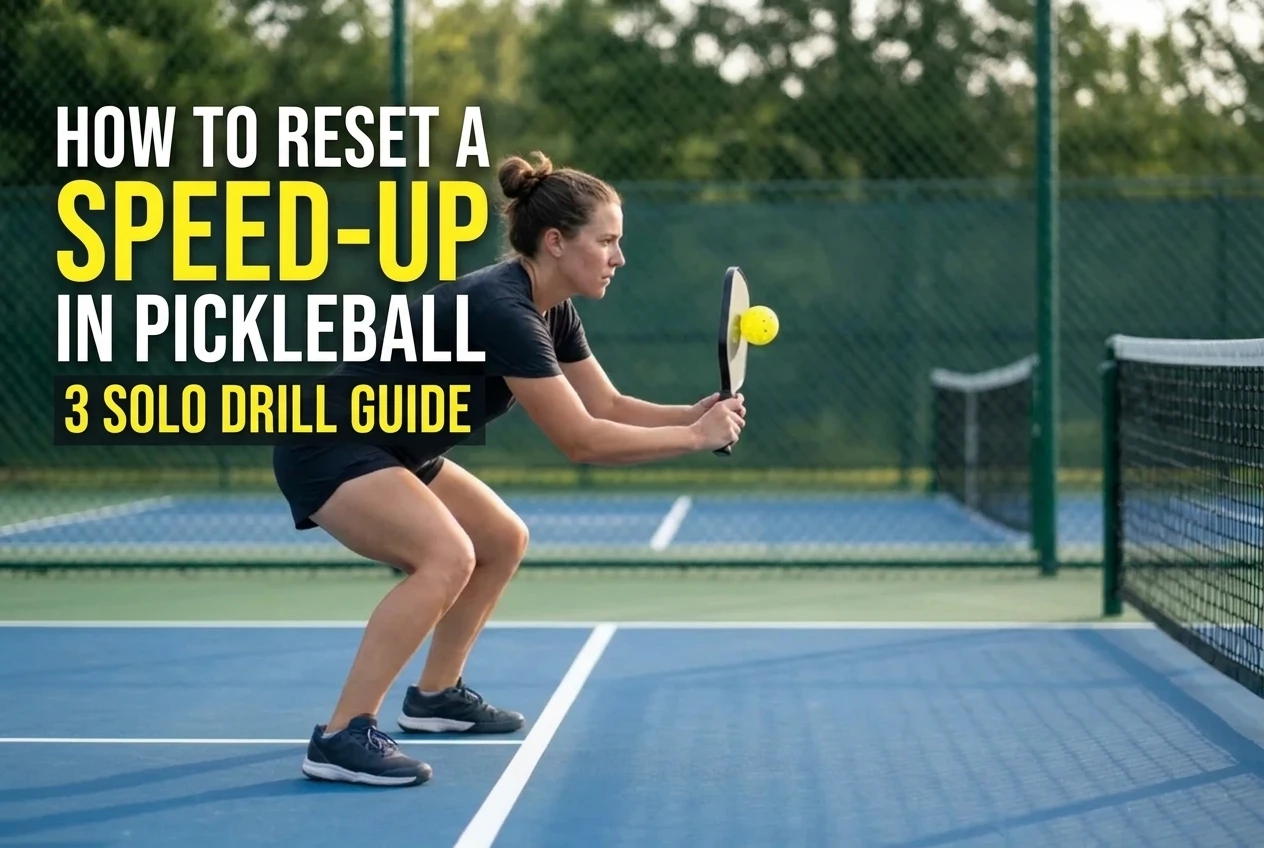
Bend your knees and lower your body so the paddle meets the ball at its natural height, instead of reaching down or up with your arm. Keep your weight balanced, or slightly forward, and take a small split step as your opponent hits so you can move either way. Your legs do the adjusting, which keeps the paddle’s position consistent.
Contact point
Make contact in front of your body, with the ball between waist and chest height if possible. Contact beside or behind your hip gives you no time to control the face. When the ball comes at your body, step back a little or turn your shoulders so the contact point stays in front of you.
Follow-through
Keep it short. The paddle meets the ball, stops or nearly stops, and then tracks a few inches toward your target. A long push sends the ball deep and fast. Many players find it useful to hold the finish position for a second after contact to confirm the paddle face did not move.
Why your resets pop up: the three most common physical errors
When a reset floats up into your opponent’s strike zone, one of these errors is usually the cause.
1. A tight grip with an active wrist. When you squeeze the handle and flick the wrist at contact, the paddle acts like a spring. The ball rebounds quickly and high. If your resets sail long or sit up above the net, check your grip first.
2. Late contact. If the ball is already beside or behind your body, you end up scooping at it with your arm. The face opens, and the ball rises. This often happens because your paddle was down at your side and your feet were still when the ball was hit. The ready position (paddle up, in front of you) fixes the timing.
3. Straight legs and a lifting arm. Standing tall means the ball arrives below your paddle, so you lift it with your arm and tilt the face open. Bending your knees gets the paddle to the ball without that lift. If your resets pop up most often on low balls, your legs are the first thing to look at.
If you are not sure which error is yours, film a few resets from the side with your phone. The video will usually show the problem faster than feel will. If your third shot drop pops up for similar reasons, why your third shot drop keeps popping up covers that shot.
Solo routine 1: The wall block, building soft hands at close range
You need a flat wall, a pickleball and a clear space. Because you will be hitting balls at speed, wear eye protection; the pickleball eye protection and injury prevention gear guide explains what to look for.
Setup: Mark a line on the wall at net height (34 inches in the middle of a pickleball net). Stand about 6 to 8 feet from the wall in your ready position.
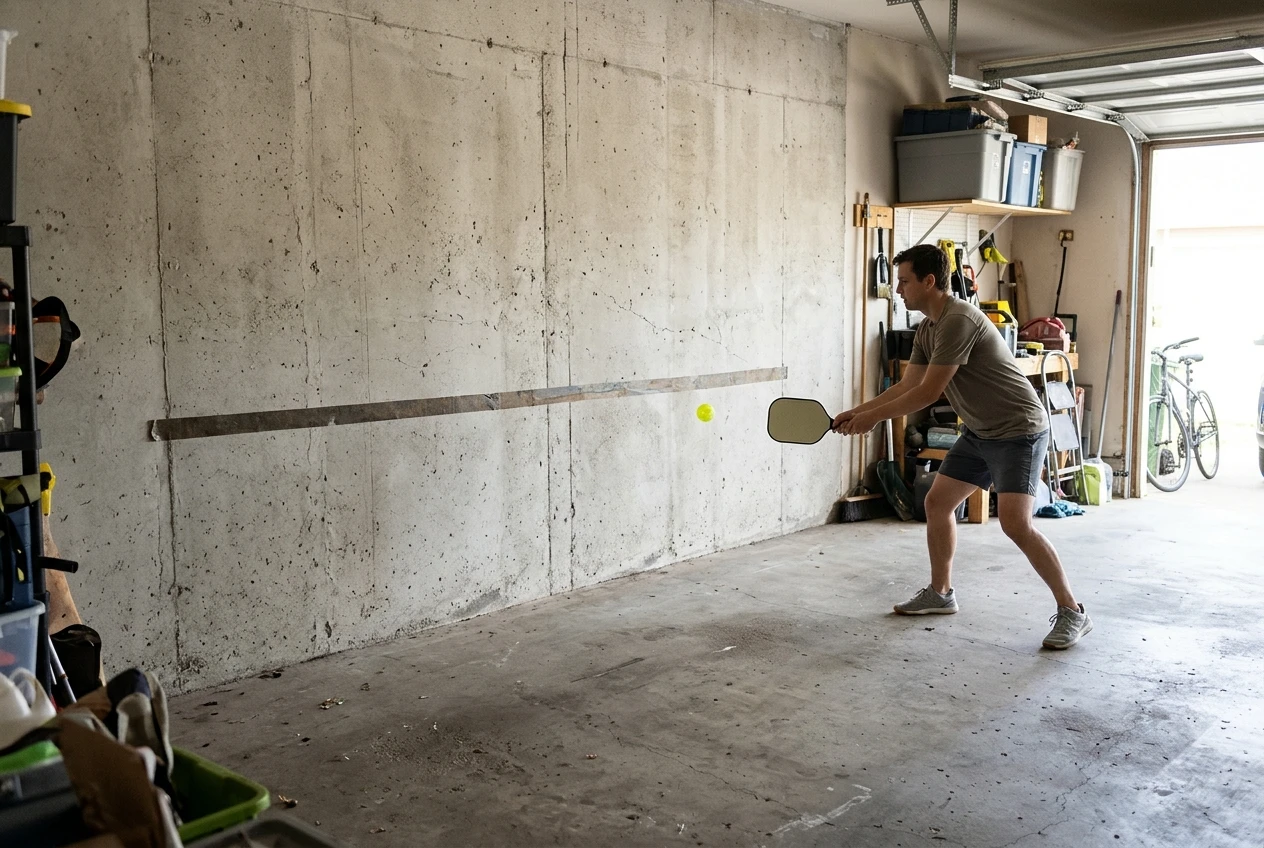
The drill:
- Hit the ball at the wall with a firm, compact swing so it comes back to you at moderate pace.
- Block the rebound with a loose grip and a still paddle face, so the ball goes back to the wall with very little speed.
- Keep blocking each return. A good block comes back slowly and bounces once or twice before reaching you.
What to watch: The ball should travel back to the wall and return slowly. If it comes back faster each time, your grip is tight or your paddle face is moving. If it pops high, your face is too open.
Progression: Start at 8 feet and count how many blocks you can string together. Once you reach 10 in a row, move closer or hit the first ball harder. Closer distance reduces your reaction time, which is closer to what a kitchen line speed-up feels like.
Solo routine 2: The bucket and target reset, training depth and landing zone
The wall builds feel. This routine trains where the ball lands, and it works best on a court with a net.
Setup: Place a bucket of balls beside you. Stand a step behind the kitchen line. On the other side of the net, set a target in the kitchen, such as a towel, a bucket or a few cones, about a foot or two beyond the net. A line of tape across the kitchen also works if you want a depth zone instead of a spot.
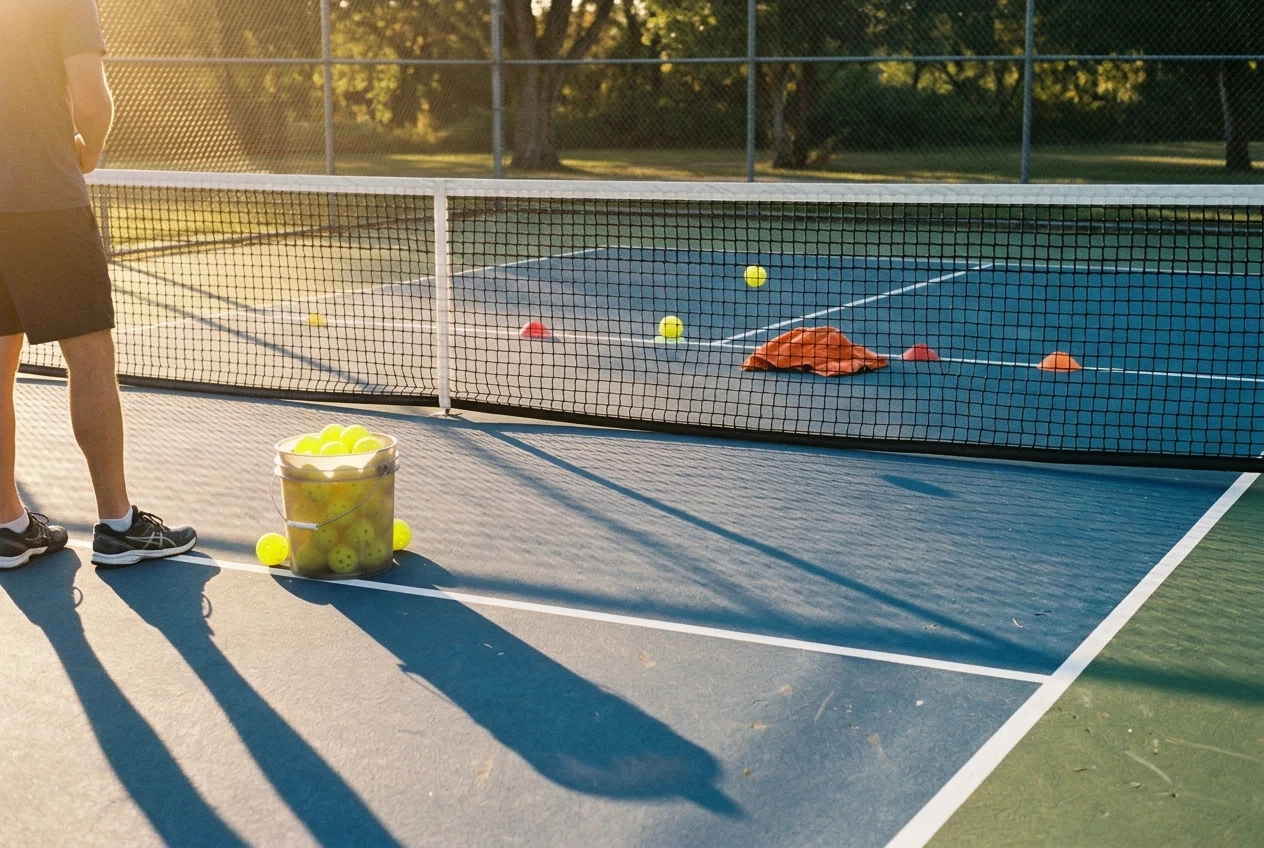
Feeding yourself a fast ball: Pick up a ball and throw it hard down onto the court a few feet in front of you, so it bounces up toward your chest or hip at speed. Throw it from different angles to practice forehand, backhand and body-level balls. The bounce pace is not identical to a real speed-up, but it is fast enough to train the mechanics.
The drill:
- Feed yourself a ball, split step and block it over the net.
- Aim to land it in the kitchen, ideally near your target.
- The ball should peak close to the net and drop soon after.
Scoring: Do sets of 10 and count how many land in the kitchen. Count a second number for how many land within reach of your target. Write both numbers down.
If you want more ideas for landing zones, pickleball target box training covers target setups in more detail. Solo feeders and other equipment are covered in pickleball training aids worth buying for solo practice.
Solo routine 3: The shadow reset, training footwork and paddle position without a ball
The shadow reset removes the ball entirely so you can focus on position. It takes up almost no space, and you can do it in a garage or living room.
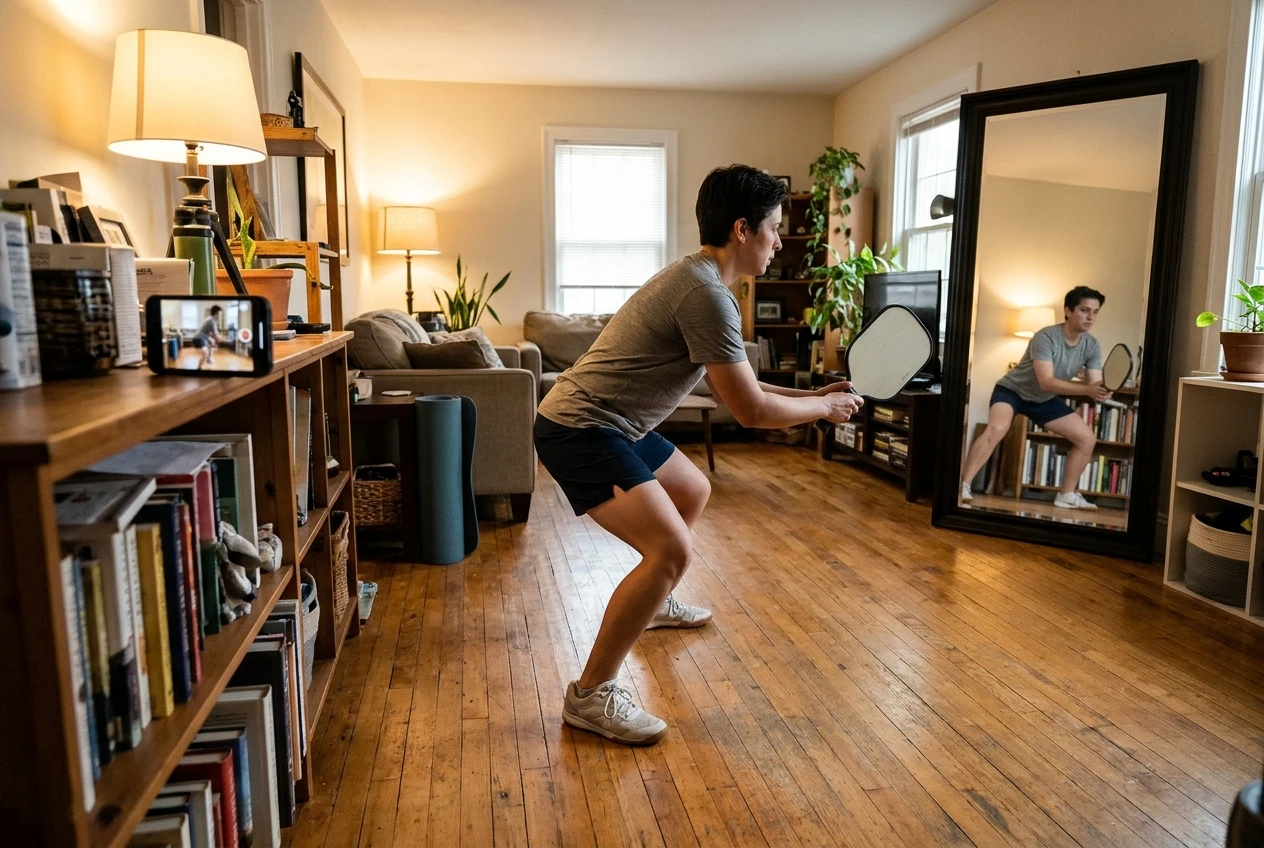
The drill:
- Stand in your ready position with the paddle up in front of you and knees bent.
- Imagine a fast ball coming to your forehand. Take a small split step, shift your feet, and move the paddle to meet the imagined ball in front of your body.
- Stop the paddle at contact. Hold the position for two seconds and check your grip, paddle face, knees and contact point.
- Return to ready position and repeat to the backhand side, then at your body.
Do 10 reps to each target. A mirror or a phone propped to record from the side makes the checks easier. Look for a vertical paddle face, bent knees and a paddle held out in front of your body.
The shadow reset is useful because it separates position from timing. Once the movement is automatic, the wall and bucket routines give you the ball to go with it.
How to build the three routines into a 20-minute session and know you’re improving
A short session works because soft-hands practice depends on focus. Once you tire, your grip tightens and the practice gets worse.
A 20-minute layout:
- Minutes 1 to 4: Shadow reset, 10 reps to each of the forehand, backhand and body targets.
- Minutes 5 to 12: Wall block, restarting your count each time the ball gets away from you.
- Minutes 13 to 19: Bucket and target reset, two or three sets of 10.
- Minute 20: Write down your best wall streak and your kitchen landing counts.
If you lack access to a court or wall on a given day, do the shadow reset alone. Doing a short practice often matters more than doing a long one rarely.
To judge progress, compare numbers from one session to the next. A rising wall streak means your grip and paddle face are steadier. More balls landing in the kitchen means your depth control is improving. A few weak sessions in a row are normal and usually mean you were tired or rushed.
Taking resets from solo practice into live points
Solo practice trains the movement, but a live point adds pressure and a second player. Expect your first few live resets to be worse than in practice. The goal in play is to keep the same mechanics when the ball is faster and the opponent is watching.
A few habits help:
- Keep your paddle up and in front between shots, so you are never starting from your side.
- Choose the reset on purpose. When a ball comes at your body or at hip level, block it instead of attacking.
- Aim for the middle of the kitchen first. A safe landing in the kitchen is better than a close miss on the edge.
- After the reset, reset your feet and paddle for the next ball. Opponents often speed up twice in a row.
Once your resets land reliably, the exchange often turns into a dink rally, and pickleball dinking drills can help you keep working from there.
Use this self-check after a few live games:
- Did you feel your grip loosen when the ball came fast?
- Did the ball land in the kitchen on most resets?
- Was your contact point in front of your body?
- Did your knees stay bent through the shot?
If you answer no to one of these, go back to the matching routine. A no on grip points to the wall block, a no on landing to the bucket and target reset, and a no on contact point or knees to the shadow reset.
Pick one of the three routines and run it in your next solo session, then check your progress against the self-check above. If you want help with your own resets, book a coaching session.